Showing posts with label Executive Coaching. Show all posts
Monday, March 20, 2017
Shuttle Diplomacy
A good way to start the week is by contemplating on what we are set to achieve in the next 7 days. Conventional wisdom suggests it is best to focus on the positives and visualise the outcome we desire, much like that long drive in Golf, when we can picture the ball landing on the green after a perfect lift through the air. But as in Golf, so at work and life, it is smart to be mindful of the hazards that lie on the way. Anticipating potential obstacles are traits of achievers.
As leaders our only job is to help our teams succeed. In doing so, we empower them and also provide guidance and coaching. But, we largely leave them to fight their own battles. Surely, that is the recipe for personal growth and hardened by these struggles emerge the leaders of the future.
To read more Click here
Tuesday, October 04, 2016
Is trust over-rated at the workplace ?
Trust begins with one's own self
![]() |
| Pic from Net |
Article first published in +Medium Click here
Trust as a function of leadership — is a current flavour of the season. It is not really a new concept or discovery. But, as in life so in organisations ideas keep coming back. There is, probably, a larger existential reason for it. Over time – values wither to a point of being dysfunctional – that is when nature’s own correction mechanism sets in to restore balance.
Corporate culture was never selfless. Dog eat dog is an old adage. Far from eschewing canine meat in favour of healthier alternatives — the pressures of quarterly results and investors breathing hot air through the ducts of the Boardroom have made organisations more ruthless. Consequently. – professional shelf-lives are shrinking putting ambitious youngsters on an overdrive. In an age of fitness mania – the proverbial rat-race has changed into a sprint up the stairs of a high-rise. In their frenetic rush to reach the sky – there is little time to cultivate deeper personal values for most. Andy Grove of Intel wrote “only the paranoid survive”. Doubt if by that he meant personal paranoia and insecurity — which frequently manifest among today’s C-suite executives.
The result of course is not difficult to predict – fast burn-outs, messed up personal lives and relationships, psycho-somatic ailments and personality disorders. The bottle, sedatives and in some cases substance of abuse (read drugs) are just an arm’s length away. Along the way it wrecks havoc in organisations and families.
So, where does trust come in all this ?
![]() |
| Pic from Net |
We talked of leaders we both admired and even those we did not — despite, in some cases, their truly outstanding successes. We also discussed colleagues — some who had moved ahead and others who were left behind or remained stuck. He shared a few recent snippets — that left me a trifle disturbed as it briefly shattered the image I had of some people. That led me to ponder over worlds like trust, betrayal, loyalty and gratitude.
Here are a few jottings in no particular order of importance:
- Trust is what everyone expects from people but not many are able to place it on others;
- Both developing trust and feeling the need to trust (others) comes with age and (life) experience; As we grow older — the illusions of invincibility get toned down and we become aware not just of our limitations but also — albeit at a sub conscious level — mortality. But, those with higher Emotional Intelligence tend to mature faster and realise that these softer human values are the true and enduring differentiators of leadership.
- Like most human traits — trust is part nature and part nurture. It is important to strike a balance between the two. Sometimes nature has to be corrected or compensated by nurture;
- Don’t be naive; But, don’t be cynical either. And, certainly don’t become bitter if let down or betrayed by someone you trusted;
- Do not expect anything in return from trusting people; Most importantly do not look for loyalty from people you trust. People are loyal to their needs and not to individuals;
- The rewards of trust does not come by way of gratitude or even accomplishment — but through internal growth that takes one to the next level of self-actualisation;
- Not everyone can bear the burden of gratitude; Being grateful requires genuine strength of character — to accept one’s own vulnerability and weakness which is not easy;
- Remember the number of times others have trusted you unilaterally; how that made you feel and how it shaped your attitude towards them; How often did you go back to thank them?
- Trust is not weakness it is means strength; It is about taking risks, making mistakes and preparedness to accept failure (for trusting the wrong person); That is the hall mark of true leaders — that sets apart the stars in a crowd of wannabes and losers.
- Never look back — if you trust someone and he/she has delivered say ‘thank you’ and move on.; if they have failed to deliver despite best efforts — say thank you all the more and if they have betrayed or let you down — buy them a drink as in the process made you wiser and a better human being;
Finally, trust is all about us. Before trusting others we must learn to love and trust our own self. Once we are able to do that — the rest becomes easy. Does not matter if those you once trusted think you are hallucinating — because the joke will then be on them.
#Trust #Leadership #Gratitude #Coaching #Psychology
Tuesday, September 27, 2016
The Emami Gurukul
Book Review: Business the Emami Way
Article first published +BusinessToday Click here
As a child one heard of an allegorical tale of a village barber. He used to carry out minor surgeries for the villagers. Then came along a crafty quack who said to the barber: "You are so naturally gifted; now if only you had a formal training you could become a top surgeon." The simple barber swallowed the bait and asked the quack to teach him. And that was the end of his practice. Each time he picked up the implements he got scared at the thought of what could go wrong. He could no longer trust his intuition and native skills; the burden of medical theory paralysed his craft. Reading Business The Emami Way reminds me of that fictional barber - for reasons I shall come to in a bit.
R.S. Agarwal and R.S. Goenka are the stuff legends are made of. They are phenomenal entrepreneurs who started small by moonlighting while still working for one of the largest industrial groups. From there, they went on to build an empire taking on formidable FMCG multinational giants. They did with FMCG personal care products what Karsanbhai Patel of Nirma achieved with detergents; then gradually expanded into other FMCG categories like edible oils and retail pharmacy chains. To deploy the surplus of the low capital intensity consumer products business, Emami made lateral forays through joint ventures into healthcare and real estate. Nirma had, on the other hand, ploughed back its cash for upstream industries like Soda Ash and Linear Alkyl Benzene. It may not be sheer coincidence that both Nirma and Emami will soon be battling it out in the cement markets of Eastern India.
What could have been an enthralling saga of their fascinating journey from bean counters to business tycoons - gleaning management and life lessons along the way - has been marred by adopting a guru-shishya dialogue format. The "gyan" that is dispensed may sound to an evolved reader rather elementary, often laced with cliches and time-worn quotes like "Time and tide waits for no one". On how to conduct effective meetings, it is advised that "secretaries of the top bosses should collect all related facts and information for the department or departments and present it before the bosses". To check interruptions, it is suggested the boss hang a 'Do Not Disturb' sign outside his office. But if friends drop in announced, one needs to make time for them (so as not to appear "downright impolite"), but "do not go overboard".
Discourse about market segmentation, socio-economic classification and attitudinal difference between rural and urban consumers are in the same simplistic vein. But, all of it is grounded in strong earthy wisdom, cutting the chase - which is something professional managers and fledgling entrepreneurs can imbibe from the Agarwal-Goenka Gurukul.
The most interesting part of the book lies in "a leaf from my life's book" at the end of each chapter, which by itself could have been a rich read if chronicled in some more detail and depth. There was, perhaps, no need to laboriously plod through management theories like teaching human anatomy to the barber.
Saturday, August 13, 2016
White Collar separtions — Preparing for a rainy day
Large-scale white-collar displacement at middle and senior levels is a relatively new phenomenon and that too without the safety net of trade unions.
Article first published in www.hrktha.com click here to read
With reforms and economic liberalisation also comes a loosening of the rigid structures of industrial regulation. A natural corollary of free market competition is allowing greater leeway to businesses for managing their operations. And a key variable of that is manpower headcount.
It is not as if mergers, acquisitions and retrenchments were unknown in India. But, traditionally, they took place within a safety net where primarily trade unions negotiated on behalf of their constituents. However, large-scale white-collar displacement at middle and senior levels is a relatively new phenomenon in the Indian business environment, which both employees and employers are ill equipped to handle. Consolidations, buyouts and exits are fast becoming the order of the day. Inefficient units — often burdened with huge debt — are being forced to sell out by lenders as banks try to get rid of their non-productive assets (NPAs). Home-grown entrepreneurs and promoters cash in on the entry of international majors and global brands as the Indian market opens up. Others simply feel the need to cut the flab, get leaner and fitter in a competitive environment.
This is new uncharted terrain, both for employees and employers. It will take some time for organisations to develop HR processes to deal with such situations. Till then, companies may be prone to handling separations in a ham-handed and, if one may say so, even selfish manner, which can displace many lives and families.
People like to believe that pink slips and retrenchment — like terminal ailments and fatal accidents — happen only to others. But, in a volatile, uncertain and fast changing world it pays to ‘be prepared’, as the Boy Scouts say. Here are a few tips on how to go about it:
• Reality check: To begin with, it is important to be realistic about one’s place in the organisation. A periodic objective self-assessment is a healthy practice like annual medical check-ups. As organisations become less patriarchal and impersonal there is no need to be apologetic about putting one’s career first.
• Looking around: Part of the reality check process is also a regular market scan and scenario analysis. A sense of which direction the organisation is headed is a critical data point in determining one’s own prospects and next career moves. Warning signals in the sky have to be read early. It is wise to get off and mount another horse while one’s career graph is on the ascendant than when it has plateaued or is dipping.
• Sharpening the saw: Very often we stop learning on the job. Being ahead of the knowledge curve is imperative to stay relevant in today’s knowledge economy. So, continuously invest in self-development — both in domain expertise and leadership skills — to maintain professional currency.
• Worshipping false gods: Do not get lulled into complacence. Many bosses feel it is their responsibility to paint a rosy picture for their subordinates. Always take blanket ‘FOB’ (Future is bright) statements with a pinch of salt. Critically look at the boss’ own track record of delivering on promises and her/his position within the organisation. Does the boss have the necessary clout or authority to give assurance to people or is she/he simply doing lip service? While trust is important, blind faith is being professionally naïve. Many a ‘God’ at the workplace has been known to let down ‘devotees’ in moments of crisis — driven by the age-old instinct of self-preservation.
-
• Timing is everything: If there are signals of a storm ahead, jumping the ship too early may be as much a mistake as staying on too late. Unfortunately, in the tough world of business there are no bravery awards for the last man standing. If separation is inevitable, then it is best to leave at a time of one’s own choice — as far as practical — and avoid ‘distress sale’
• Garden leave: Yet, there can be no perfect moment. Therefore, it is important to prepare the family for a rough patch ahead without making them feel insecure. At the same time, one should be mentally prepared to take a short career break, sabbatical or ‘garden leave’ as it is fashionably referred to these days.
• Leave on a positive note: Redundancies and displacements at the time of mergers, acquisitions and restructuring are becoming common today. Organisations, therefore, do not hold it against new incumbents and judge them on merits — unless background checks throw up any strong negatives either by way or competencies — or more importantly, integrity. Hence, it is prudent not to burn bridges while quitting or leave in a cloud of smoke.
• Rediscover the self: During a long career, we seldom have the time to sit back, reflect and take stock of life. Treat a career recess as an opportunity for that. Dive deep into the self to discover your strengths, values, dreams and aspirations. Re-establish contact with your inner self to get answers to these questions and visualise a picture of what you want to do with the rest of your life. Reflect on the goals, opportunities, enablers and challenges.
• Reach out: Empirical evidence suggests that loss of job is among the three major causes of depression. Therefore, do not allow the psychological impact of separation affect you. Granted that is easier said than done — so do not feel shy of seeking help. Sometimes, going on a retreat like Vipasanna can work wonders for individuals. Talking to a counsellor, a professional life and career coach or a qualified psychologist can also be of great help. Many companies have begun to sponsor the latter for parting employees.
• Stay positive: Attitude is the key. Many people have found, to their surprise, that such forced separations have opened up new doors that they had never imagined existed before. Therefore, it is important not to lose either self-confidence or self-esteem. Faith — whatever it might mean to you — helps one stay rooted and centred.
• Be flexible: Keep an open mind to opportunities. If it means temporary dislocation or living away from the family, it might be a pain worth taking for a brighter future. Above all, don’t panic. You are not the only one to go through a rough patch or a career trough. It happens to the best of us.
• Be a hard negotiator: While discussing a ‘handshake’, make sure it is at least made of stainless steel if not gold or silver. Similarly, if the organisation wants to retain you through the period of transition, ask for your price by way of a retention bonus. Either way, do not let HR colleagues (who have their own KRAs to meet) short-change you with hugs and kisses and keep the goodies at the time of saying good-bye.
• Don't jump into fire: should you decide to stay on after a take-over, do your own due-diligence about the new employer — especially on cultural issues, remuneration structure and business ethic. There is little point in jumping from the frying pan into the fire. At senior levels, it may be possible to even negotiate a ‘pre-nuptial’ separation package with the new company — in the event of things not working out after a time. This is increasingly becoming standard industry practice, and therefore, worth checking out.
Finally, we are as much the masters of our careers as we are of our own destinies. Tom Peters, American writer on business management practices, said that we are the CEOs of our own company — Me Inc. Let us believe and behave as one.
© 2016 HR Katha
Friday, March 27, 2015
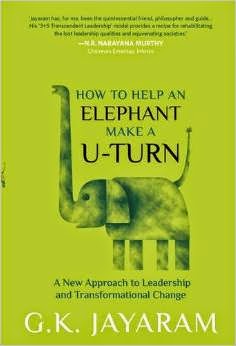
How to help an Elephant Make a U-Turn
Book Review
How to help an Elephant Make A U-turn
– a new approach to leadership and
transformational change, G.K. Jayaram, Maven / Rupa, 258 pages
Dear Jaya,
I am taking the liberty of calling you by your first name –
since in the ‘’author’s note’’ you invited the reader to ‘talk to you’ (over a
mellow drink, at that) rather than simply ‘read’ the book. Actually – that’s a novel (pun intended) way
to have a lesson on leadership and I quite like your style.
I picked you up (no pun intended there) at the
Higginbotham’s in Chennai Airport during a long layover between flights. Over the years I have become a bit wary of
books on leadership – with practically every other superannuated executive turning
into a leadership coach and writing a book. Much of what they write – to twist one of your quotes – works neither
in practice nor in theory. But, the
green jacket held my attention and what caught my eye were the words
“Transformational Change”. Flipping the
pages I found myself being seduced by another term “transcendental
leadership’’. So, is this guy talking of personal transformation as a key to
change and leadership? – I asked myself and there you got me hooked.
I was fascinated by the concept of RORE – ‘revolution of
rising expectation’. What could be more relevant for a country of young people
like ours waiting to break free in the world. It is truly an empowered
generation with a mind of their own, who believe in their abilities and think
they are not less than equal to anyone – what you call PROBE ( Promise in and
Belief of Equality). The challenge, therefore, is as much for the business or
corporate leader - as it is for the
societal and political leadership – in how to harness this energy, transcend
the past as also the immediate and practical (pragmatic) to create
transformational change.
I am glad that you have taken the concept beyond the narrow
and limited framework of corporate organisation to society at large – because
the issues facing leaders dealing with a young restless professionals who see
sky as the limit or the small town graduate coming from an humble homes - no longer recognise any sense of
‘’entitlement” and want to reach the top solely on merit and by dint of their hard
work.
Today’s leaders must recognise this tectonic shift (to use a
cliché) in attitude and aspirations – otherwise they risk losing talent in
organisations just as the old world politicians will find themselves hopelessly
disconnected from the ‘gen-next’ voters.
Frankly – I don’t care much for the testimonials and
interviews you have laced the book with. To be blunt – they came across to me
as your ‘’Infy’’ Groupies or the Bangalore Club cronies – who intrude into our
quiet chat at the Bar. Over-laden with the quotes and excerpts from other
leadership and management classics the so called “Leader-Speak” were a distraction. But, I thought it was a
great idea to bring in contemporary examples of the Anna movement and the infamous
fall of the Indian ‘poster-boy’ of corporate America to bring home the
importance of integrity, intensity and imagination in your 3 + 5 Model of Transcendental Leadership.
It’s easy to understand – why Narayana Murthy calls you the
“quintessential, friend, philosopher and guide”. I can relate to you as one –
virtually – even not having met you in person.
Warmly,
Sandip
PS: Hope you have gifted an autographed copy to the Prime Minister. The
subject would be right up his street. And, even young Arvind Kejriwal – could
do with one so that he can “transcend’’
the past mistakes of his own and that of his former mentor – that you so graphically describe in the
book – and move on to a higher order of transformational leadership.
Article first published in Business Today issue April 12, 2015
Thursday, August 25, 2011
the corporate gigolos
Neil Bose – my friend in college, a bright student otherwise – failed to get a first class in his Economics Honours. Calcutta University, of course, applied standards of evaluation that could easily make an Oxford Don stumble. Disheartened and disgusted with our examination system, Neil threatened to write a guide-book on “How to get a First Class – written by a ‘Second Class’ student”.
It’s an old adage – “those who can do, and those who can’t teach”. A great teacher need not necessarily have been a brilliant student – though, there is nothing to prevent it from being the other way round. The same true not just in academics but also in other fields of life – especially sports or music. Some of the best sports coaches - weren’t the champions of the game. Very often – in their own careers they fell short of reaching the top – despite being hugely talented. Chances are – they didn’t get the lucky breaks – but more likely they weren’t temperamentally cut-out for making it big. It is from their failures though they learnt the rules and tricks of success – which they could put to use good use in training others.
Old Boys' Badge Value
Executive Coaching – popular abroad, especially in the US, for quite some time - is catching on India like so many other western fads. Many former senior colleagues connecting on Linked-In and Facebook mention “Executive Coach” as their current occupation. Most of these are glorified announcements of “disguised unemployment”, but still some, I am told, have made a successful practice of it – adding handsomely to the generous superannuation package endowed in their favour by past employers. They largely rely on word of mouth recommendations of friends – much the same way they land on company board memberships through ‘old boys’ network.
Like external directors how much value they really add – is questionable. Only a few amongst them have actually undergone any kind of formal training or have an accreditation for coaching. Many don’t even have a HR or Organisation Behaviour (OB) background. A coach is supposed to operate somewhere between a mentor and a therapist. It requires certain skill sets and competencies like any other profession. These people generally don’t have any such specialization and fly by the seat of their pants. But, still they do have takers.
First, there is a badge value. It’s fashionable to have an executive coach these days – if you are seen to be a high-flyer within the organization. It’s almost like the craze among the rich, famous, yuppies and wannabes for personal trainers at their private gyms. A friend in the HR circuit educated me, it’s a ‘win-win’ formula. Earlier, companies would send their ‘hi-po’s for professional development or advanced management programmes to top management schools. Now, if you are of an employee of any value – it is difficult for an organization to spare you even for a couple of weeks to attend courses. And, even if they do – the incumbent is scared if he or she’d have a job upon return. For this – appointing a coach is a convenient solution. It probably costs as much or less than an external programme and the coachee doesn’t have to take time off from his or her job. Following a round of coaching and mentoring, there are usually some visible behavioural changes, which get reflected in 360 degree appraisals, at least in the short-term, that makes everyone – the boss, the sub-ordinate, his reports and peers – happy, setting in motion a self-fulfilling virtuous cycle.
a susegad after-life
If you have been wondering – where I am leading you to with all this circumlocution, it’s about alternative vocation options, something that I have been pondering over for a long time. There are only a few people I know, who have been able to make a successful career in mid-life or later. It’s not easy to re-invent one-self. Re-skilling is one of the most difficult tasks – though we may not always realize it. Displaced populations – land losers especially – realize it at the hard way. But, this is the “Age of Unreason” – Charles Handy, the Oil Company Executive turned management Guru and Corporate Philosopher had written about. It’s a modern day challenge to prepare for that day of reckoning – otherwise, we are left holding an “Empty Rain-Coat” – to use another Handy title – shorn of our corporate trappings.
Of course, a susegad (socegado) life in Goa would be what the doctor ordered for me. But, even my young daughter refuses to take me seriously when I talk about it. A moderate climate hill-station like Coonoor would have been good too. But, these places are fast getting crowded and running out of basic necessities like water. The bigger question, however, is having neither a hefty retirement corpus nor any other source of annuity - how will I sustain myself. The cost of medical treatment itself is frightening.
Using the same convoluted Bosean logic ( Neil, no relation of the now famous D K Bose), I think - I would have made a decent Corporate Coach (among so many other things) if only I had taken the pains to archive and chronicle all my mistakes and failures in corporate life. Coming to think of it – I have learnt more from bad bosses – some of them, of the Hari Sadu variety - than the ones for whom I loved to work. But, alas I don’t have either the network of contacts or the gravitas. A friend suggested that, a way to overcome the latter could be by getting into tele-coaching – where the coachee would not be able to see me. It seems – the client opens up more when he is not sitting under the glare of the coach or mentor in a chair or a couch – but instead relaxing on his potty or lying in bed with just undies on - scratching his front or back as a thought stimulator. Somehow, it sounds like being a corporate phone gigolo and doesn’t quite appeal to my finer sensibilities.
So my quest – for a corporate ‘after-life” continues. Till then, my downhill slide from one soul breaking job to another is ordained to continue – soaps and shampoos to sanitary napkins and diapers; (news)paper to concrete, as it were.
Any suggestions are most welcome !!
Subscribe to:
Comments (Atom)