Showing posts with label Book Review. Show all posts

Tuesday, September 27, 2016

The Emami Gurukul


Book Review: Business the Emami Way

Article first published +BusinessToday Click here 


As a child one heard of an allegorical tale of a village barber. He used to carry out minor surgeries for the villagers. Then came along a crafty quack who said to the barber: "You are so naturally gifted; now if only you had a formal training you could become a top surgeon." The simple barber swallowed the bait and asked the quack to teach him. And that was the end of his practice. Each time he picked up the implements he got scared at the thought of what could go wrong. He could no longer trust his intuition and native skills; the burden of medical theory paralysed his craft. Reading Business The Emami Way reminds me of that fictional barber - for reasons I shall come to in a bit.


R.S. Agarwal and R.S. Goenka are the stuff legends are made of. They are phenomenal entrepreneurs who started small by moonlighting while still working for one of the largest industrial groups. From there, they went on to build an empire taking on formidable FMCG multinational giants. They did with FMCG personal care products what Karsanbhai Patel of Nirma achieved with detergents; then gradually expanded into other FMCG categories like edible oils and retail pharmacy chains. To deploy the surplus of the low capital intensity consumer products business, Emami made lateral forays through joint ventures into healthcare and real estate. Nirma had, on the other hand, ploughed back its cash for upstream industries like Soda Ash and Linear Alkyl Benzene. It may not be sheer coincidence that both Nirma and Emami will soon be battling it out in the cement markets of Eastern India.

What could have been an enthralling saga of their fascinating journey from bean counters to business tycoons - gleaning management and life lessons along the way - has been marred by adopting a guru-shishya dialogue format. The "gyan" that is dispensed may sound to an evolved reader rather elementary, often laced with cliches and time-worn quotes like "Time and tide waits for no one". On how to conduct effective meetings, it is advised that "secretaries of the top bosses should collect all related facts and information for the department or departments and present it before the bosses". To check interruptions, it is suggested the boss hang a 'Do Not Disturb' sign outside his office. But if friends drop in announced, one needs to make time for them (so as not to appear "downright impolite"), but "do not go overboard".


Discourse about market segmentation, socio-economic classification and attitudinal difference between rural and urban consumers are in the same simplistic vein. But, all of it is grounded in strong earthy wisdom, cutting the chase - which is something professional managers and fledgling entrepreneurs can imbibe from the Agarwal-Goenka Gurukul.

The most interesting part of the book lies in "a leaf from my life's book" at the end of each chapter, which by itself could have been a rich read if chronicled in some more detail and depth. There was, perhaps, no need to laboriously plod through management theories like teaching human anatomy to the barber.

Friday, March 27, 2015

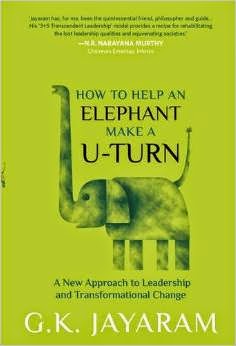
How to help an Elephant Make a U-Turn

Book Review


How to help an Elephant Make A U-turn – a new approach to leadership and transformational change, G.K. Jayaram, Maven / Rupa, 258 pages


Dear Jaya,

I am taking the liberty of calling you by your first name – since in the ‘’author’s note’’ you invited the reader to ‘talk to you’ (over a mellow drink, at that) rather than simply ‘read’ the book.  Actually – that’s a novel (pun intended) way to have a lesson on leadership and I quite like your style.

I picked you up (no pun intended there) at the Higginbotham’s in Chennai Airport during a long layover between flights.  Over the years I have become a bit wary of books on leadership – with practically every other superannuated executive turning into a leadership coach and writing a book. Much of what they write –  to twist one of your quotes – works neither in practice nor in theory.  But, the green jacket held my attention and what caught my eye were the words “Transformational Change”.  Flipping the pages I found myself being seduced by another term “transcendental leadership’’. So, is this guy talking of personal transformation as a key to change and leadership? – I asked myself and there you got me hooked.

I was fascinated by the concept of RORE – ‘revolution of rising expectation’. What could be more relevant for a country of young people like ours waiting to break free in the world. It is truly an empowered generation with a mind of their own, who believe in their abilities and think they are not less than equal to anyone – what you call PROBE ( Promise in and Belief of Equality). The challenge, therefore, is as much for the business or corporate leader  - as it is for the societal and political leadership – in how to harness this energy, transcend the past as also the immediate and practical (pragmatic) to create transformational change.

I am glad that you have taken the concept beyond the narrow and limited framework of corporate organisation to society at large – because the issues facing leaders dealing with a young restless professionals who see sky as the limit or the small town graduate coming from an humble homes  - no longer recognise any sense of ‘’entitlement” and want to reach the top solely on merit and by dint of their hard work.

Today’s leaders must recognise this tectonic shift (to use a cliché) in attitude and aspirations – otherwise they risk losing talent in organisations just as the old world politicians will find themselves hopelessly disconnected from the ‘gen-next’ voters.
Frankly – I don’t care much for the testimonials and interviews you have laced the book with. To be blunt – they came across to me as your ‘’Infy’’ Groupies or the Bangalore Club cronies – who intrude into our quiet chat at the Bar. Over-laden with the quotes and excerpts from other leadership and management classics the so called “Leader-Speak”  were a distraction. But, I thought it was a great idea to bring in contemporary examples of the Anna movement and the infamous fall of the Indian ‘poster-boy’ of corporate America to bring home the importance of integrity, intensity and imagination in your  3 + 5 Model of Transcendental Leadership.

It’s easy to understand – why Narayana Murthy calls you the “quintessential, friend, philosopher and guide”. I can relate to you as one – virtually – even not having met you in person.

Warmly,

Sandip

PS: Hope you have gifted an autographed copy to the Prime Minister. The subject would be right up his street. And, even young Arvind Kejriwal – could do with one so that he can “transcend’’  the past mistakes of his own and that of his former mentor  – that you so graphically describe in the book – and move on to a higher order of transformational leadership.

Article first published in Business Today issue April 12, 2015

Tuesday, March 11, 2008

Lady Canning lives in Japan


Last week on my way to KL again, I picked up Kunal Basu's - "The Japanese Wife" at the Mumbai Airport Crossword. Had read about the book earlier - but didn't know that Aparna Sen was making a movie out of it. The Indian edition is clearly timed for the release of the film. The jacket - well designed in matt yellow and orange with muted Japanese floral prints and tinted silhouettes of the actors (Rahul Bose and the shaven-headed Japanese woman ) has an understated western touch, which I fell for despite the old adage about not judging a book by its cover. It's a collection of short stories or short-fictions as the publishers prefers to call them.


The blurb bills it as a "surreal love story" and I felt that "surrealistic" quality in the first page itself. Starting to read it on the plane - I was at once overcome by a sense of deja-vu !! The story was set in a village - Shonai - on the periphery of the Sunderbans ,across Canning, by the bank of the Matla river - a part of Bengal to which many Calcutta bred Bongs like this one, I have no qualms in admitting, came to be introduced only recently by Amitava Ghosh's - The Hungry Tide. And, it seemed a little uncanny that, I had also bought a copy of the latter at the airport for a friend in KL, who wanted it after reading Ghosh's - Glass Palace (set partly in Malayasia ) which she liked.

It's a story of a school teacher in Shonai, who has been in a long-distance marriage for over 20 years with a pen-friend in Japan, without ever having met her in person. On first reading it appeared bizarre . The plot lacked credibility on several counts - not the least of which, even at the risk of sounding disgustingly class prejudiced like Aveek Sarkar, I would say, was the choice of the locale. 'Bhadraloks' of South Calcutta generally associate Canning with fish-sellers in Gariahat market and house-hold helps (mostly Bangladeshi migrants ) who come from that area. Even Ghosh's Hungry Tide didn't do much to redeem that image of this economically deprived and depressed part of West Bengal known as South 24 Parganas . So, it's difficult to imagine an "anker - mastermoshai" ( mathematics school teacher) from Shonai (granted, he went to college in Calcutta - that's when he developed a pen-friendship with this Japanese girl whom he discovering in a magazine, exchanged vows and consummated a 'mail-order' marriage in no time ) could maintain this strange telescopic marital relationship in full view of his villager community - both young and old - and with the explicit indulgence of his widowed aunt, who affectionately calls her "Bou-Ma". His rather urbane sounding name - Snehamoy Chakrabarti - doesn't help matters either.

And a lay reader like your lonely blogger, who has very stereotypical ideas of Japanese society and culture - from books and films not having ever visited that country - is left totally flummoxed by the character of Miyaja - the Japanese wife. We are told very little about her except that, she lives in a city on the banks of the Nakanokuchi river , writes letters in different coloured inks reflecting her changing moods and state of mind, sends him exotic gifts like kites, Hokusai prints and mountain cherries ( don't know if they arrived in refrigerated containers !!) and posts her "will" in a sealed envelope to be opened only after her death. There isn't as much of a hint about her personal situation or background - all of which are left to challenge our underdeveloped imagination.

May be it was the setting that introduced a bias in my mind. Sub-consciously, perhaps, I was expecting to see traces of The Hungry Tide, like the similarities one would have inevitably found in, say a Ray and Ritwik's treatment of comparable locational situations in rural Bengal ( I wonder how a Subodh or Santosh Ghosh would have handled such a subject). But, he is no Ghosh or a Jhumpa either. Shonai is just the name of a village in his story - it could well have been Siliguri, Sitamari or Saharanpur. I thought his style lacked polish ( considering he is an Oxford Don ), the cadence uneven, the characters sketchy and the development of the plot half-baked and disjointed.

I liked the opening tho' - including the soon-going-to be famous line : "She sent him kites", which opened up a whole world of possibilities. The description of how the box of kites was carried on various modes of transport from Canning to Shonai across the Matla made amusing reading. And, the story did come alive for once in the sequence of the 'kite - fight' in the village. But after soaring to great heights, like the giant Nagasaki kite, it too went "Bhookata" in mid-air. The parallel plot of the young widow and the child moving into the house had tremendous dramatic potential - which wasn't allowed to climax. The ending - with its deliberate twist - was the best part. And, probably there begins his story.

It is only after you put down the book - does it really begin to work on you.- almost subliminally. Gradually the pencil strokes become visible, the outlines emerge , the images get form and the pictures are filled with colour. And, you are suddenly able to read - what a reviewer called - "the sub-texts of yearnings, separations, loss and secret lives" that lie somewhere deep within all of us. That's where it begins to strike a chord. Someone once described writing as nothing but an exercise in telepathy. Is this also a telepathy of sorts ?

Is Basu going to be the next Indian writing wonder ? I'm not so sure about that. But, he definitely leaves you longing for something more. Let's see how Aparna creates magic with her Miyaja.
( PS: As those who have read Ghosh's Hungry Tide would know - the port of Canning was named after Lady Canning, as was the popular Bengali Sweet - "Lady-kini" )

Sunday, January 28, 2001

Gandhi, Marx and Ram

As a Bengali I terribly disappoint my friends at not being able to spout either Marx or Tagore. So in a belated attempt to make amends, reading Ramachandra Guha's latest book - collection of his Essays - An Anthropologist among the Marxists - but, must admit, enjoying it thoroughly. He is surely one of the finest Indian mind of our generation ( now, now .. that's not Bong chauvinism - 'cause, he is not a Bengali but a Tamilian - the surname is Guhan, someone decided to drop the 'n' along the way ). His central thesis, as the blurb says, is: 'Inside every thinking Indian there is a Gandhian and a Marxist struggling for supremacy'. He writes about Gandhians, pseudo-Gandhians, Marxists, anti Marxists and, of all things, Cricketers. Tho' it was even funnier reading the Ram vs Ram ( N. Ram vs Ram Guha ) battle on the pages of the Frontline....over what else but a woman, in this case Arundhati Roy ( 'God of Small Things' fame ). N. Ram didn't take kindly to Ram Guha ticking her off on writing about environmental issues ( Narmada Dam ) commenting that, she should stick to writing fiction ( apparently - he said something to the effect of, I am told that she has written a good novel' pretending that he hasn't read or heard about her book ). As someone else remarked the other day, Roy's tirade against him definitely sounds like love spurned or jilted at some stage. It seems before that, N. Ram had written something equally stupid about Tibet, defending the Chinese occupation, which Guha had criticised in his column. So, the polemical feud carries on.