Showing posts with label Arvind Kejriwal. Show all posts

Monday, March 20, 2017

Post UP 2017: "Bihar Model" is outdated; Opposition must find a new template


Article first published in @abplive.in  (Photo courtesy PTI via ABPNews)


It has been a week since the Assembly election results that stunned the nation came out. Politicians and media were shocked by the now seemingly unstoppable rise of Prime Minister Narendra Modi. While most people are still trying to gather their wits to formulate a response to the stupendous victory of the BJP, the discourse has been dominated by theories on the future of the Congress and Rahul Gandhi.

No doubt there has been discussion on the fate of the major losers, namely the Samajwadi Party, BSP and AAP. But, not much attention has been paid to the reactions of other regional leaders and what this mandate means for them.


To read more: Click here

Saturday, September 17, 2016

Delhi's real threat is not Dengue-Chikungunya but Kejriwal and AAP

Photo Courtesy: +ABPLIVE 


Article first published in +ABPLIVE Click here

In India, it is not news until it happens in the national capital. They say in the last two decades more people have died of malaria in West Bengal than the great famine of 1943. However, little has been written on it.

Similarly, one does not see too many statistics on the number of dengue and chikungunya deaths across the country. But, one death in Delhi and boom – the national media jumps upon it like the country is on fire. This is not to in anyway to discount the tragedy or the seriousness of the health scare that looms over the National Capital Region.

Arvind Kejriwal understands this better than most politicians and he has successfully manipulated it to his best advantage since the days of the Anna movement. He realised that an anashan in Jantar Mantar or Ram Lila Ground can get him a thousand times more mileage than a flop-show in a 100 acre Mumbai Maidan.

As a result, Kejriwal has managed to get disproportionate amount of airtime on television and column centimetres in print media, thanks to lazy journalism, than many more accomplished Chief Ministers and seasoned national leaders of long standing. No wonder he fancies himself as the virtual shadow Prime Minister with a licence to comment on anything and everything under the sun – including foreign affairs.

There are two issues at stake here, both affecting the residents of Delhi. First, of course, is the threat of a virtual epidemic which needs to be tackled on war footing. The second is the larger debate about governance in Delhi.

No matter what Kejriwal’s views may be about the powers and responsibilities of the Centre for the civic administration of Delhi, the Union Health Ministry cannot be rushing SOS teams to tackle local health issues of every State.

But, in its enthusiasm to trade blame with AAP, the BJP has missed a huge opportunity to retrieve the moral high ground from under Kejriwal’s hospital bed. It was like the BJP spokespersons trying to shoot mosquitoes in the air when it were the drains that needed cleaning up.

Where are the AAP volunteers who symbolically swept Delhi clean with “jhadus”, the BJP should have asked while hitting the streets with their own workers and RSS swayamsevaks to get MCD and NDMC do their job. That would have earned the BJP gratitude from the people of Delhi and exposed Kejriwal, not just in Delhi but also in Punjab and other States where he is contemplating an entry by AAP.

That Kejriwal is a shirker should have been known to any politically aware observer since he threw in the towel in AAP’s first term in Delhi. This impression was further reinforced when he chose to become a Chief Minister without portfolio.

He has spent his time blaming the Prime Minister and fighting with the LG when not travelling around the country to build a national image for himself as PM-in-Waiting or taking off for Vipasanna and naturopathy retreats. He did all this under the indulgent eyes of the media which for some inexplicable reason has developed a huge soft corner for him.

On his part Kejriwal has assiduously cultivated the media at large and some so-called five-star journalists in particular. Many media worthies have been favoured with coveted positions in educational and other institutions of the Delhi administration and there are rumours about one former editor becoming AAP’s Chief Ministerial face in a coastal State. Therefore, it came as a shocker when Kejriwal tweeted gutter muck at arguably one of the most formidable journalists of our times, Shekhar Gupta, and got into an unseemly spat with a TV anchor.

In the past Kejriwal has not always followed decorum or political etiquette in public life. He has hurled abuses at the Prime Minister. But in using a word like “Dalal” he has gone well beyond his own past record. At one level it reveals Kejriwal’s opinion about journalists, even very senior ones. Whether this has been formed by his own experience and how many “Dalals” masquerading as media doyens he has encountered or done business with, one cannot comment. But, it does smack of there being more to the implosion than can be seen on TV screens.

Here too Kejriwal is singled out for kid-glove treatment by his friends and admirers in the fourth estate. Imagine what the reactions would have been if another Chief Minister had made such a comment. Hell would have broken loose and would not have subsided until the person, however, high and mighty, apologised or expressed regret. The silence of the fraternity is intriguing, to say the least.

There are jokes doing the rounds on Whatsapp about how Kejriwal beat Pinocchio in a lying contest. Kejriwal seems to be on the path to disprove Abraham Lincoln’s famous quote, “You can’t fool all people all the time”.

One can understand if Narendra Modi is giving Kejriwal a long rope to hang himself. But, why is the media soft on him is not only “mushkil” to explain but almost “namumkin” to fathom.

Friday, May 22, 2015

India after AAP

The year 2014 was, perhaps, the second major watershed in post-independence India’s political history after 1977. For many political scribes of the current generation it will probably remain as the most memorable year of their career. That many of them would, therefore,  feel the urge to chronicle it as ‘instant history’ – spawning a new “Read My Book’’ genre of Indian journalism – is quite understandable. Both Ashutosh’ and Saba Naqvi’s books can be broadly classified under this category.

The first, by Ashutosh – the journalist turned activist-politician and AAP leader - has a wider sweep covering Narendra Modi’s incredible run to the Prime Minister’s office and the parallel narrative on the rise of AAP and Arvind Kejriwal. It is a flash-back or recap of events as they unfolded over 15 odd months – filling in the missing bits from his reporter’s diary supplemented with insights of an experienced political journalist.

Ashutosh is candid in admitting, he conceived the book as a journalist but by the time he finished it he had became a politician. Not surprisingly, the lines do get blurred in-between.  Thus, in a way, it is also Ashutosh’ own journey from the sets of TV Studios to the amphitheatre of politics. To his credit, Ashutosh doesn’t try to hide his political leanings and the fact that he became personally close to Arvind Kejriwal and some of his colleagues much before he joined AAP. On occasions he would even advise them on how to tackle tricky media issues (revealing Kejriwal’s high degree of dependence on and feeling of vulnerability to media). This, of course, raises the question of how Ashutosh was able to maintain his objectivity and the troubling issue of journalists consciously or unconsciously crossing the professional line and becoming a part of the political game.
Ashutosh’ description and analysis of the transformation Chief Minister Modi to Prime Minister Modi is riveting. Of course, it would be unrealistic to expect a totally balanced perspective once he takes the plunge into real politics – but it is for us readers to take it with, as they say in recipe books, a measure of salt as per one’s (political) taste.

Ashutosh clearly believes the outcome of the 2014 elections could have been very different hadn’t Kejriwal scored a ‘self-goal’ by resigning as Chief Minister. Indeed, as Ashutosh points out, many thought had Kejriwal continued as CM of Delhi – AAP might have garnered enough seats in the Lok Sabha to play ‘King-Maker’ after the elections.
Ashutosh’ explanation of why he chose to leave journalism to join AAP is not very convincing, He too repeats AAP’s favourite allegation about Modi’s nexus with big business. But, by his own admission, there was no overt pressure from the owners of the network he worked for to toe any particular political line. Therefore, one cannot quite fathom why he was apprehensive about loss of editorial freedom (any more or less than what he enjoyed through his career till then).

If Ashutosh’ was an ‘inside-out’ account of how AAP evolved within the larger political churn in the country - Saba Naqvi could have easily named her book “The Short Official History of AAP” or, by a stretch ‘’The Authorised Political Biography of Arvind Kejriwal’’.  Right from the start it is abundantly clear that the ‘idea of AAP’ had captured her imagination as did the charismatic (what some others may have found ‘enigmatic’’) leadership of Arvind Kejriwal. At the same time, she makes no secret of her deep distaste for whatever BJP under Narendra Modi stood for. The Congress in any case had lost steam and direction. Even fringe parties like BSP no longer had even a marginal utility in Delhi circa 2015. Therefore, for her AAP was not just the best choice – but, perhaps, the only choice. Therein lies the rub.

Ms Naqvi calls it a ‘’Reporter’s Book’’ and no doubt she assiduously followed AAP’s evolution at every stage and each step – right from the days of Anna and IAC (Indian Against Corruption)  Rally in Jantar Mantar.  Through this journey she developed strong links with members of AAP’s core-team –  from whom she could glean intimate details of the party’s inner workings.  But, in doing so it might appear – she dropped her guard and has been too uncritical and unquestioning in her assessment. Outside, of AAP she plays-back very few voices of other political denominations – certainly none which are critical of AAP or Kejriwal. She does quote a few anonymous sources (mostly) of BJP but only to buttress her own views.

Ms Naqvi’s original proposition at the beginning of the book is ‘’AAP...moved on principle of income groups, its focus clearly on class and not castes or communities’’. Such a strategy is not borne out by AAP’s subsequent electoral tactics. She attributes BJP’s success to getting ‘’first past the post’’ – appealing to the middle class, richer sections of society and ‘’then getting a small section of the poor’’ to vote for it – while AAP worked with a bottom up the pyramid approach. However, many analysts felt AAP’s resounding success in the 2015 Delhi Polls – at least partly - came from their mastering the electoral arithmetic well.

Like many – Ms Naqvi was impressed by AAP’s initial promise of ‘’No Lal Batti (VIP)’’ culture. However, she doesn’t comment on the subtle change in position - in their second term – when AAP Ministers are not averse to accepting the frills and perks of office. She is easily touched by tokenism such as Kejriwal breaking out into a song at his ‘swearing in’ or bringing his wife to the AAP HQ, but is silent about Arvind Kejriwal’s perceived shift in style from being ‘’consultative’’ and ‘first among equals’ to the unquestioned leader (perhaps, not ‘autocratic’ or a ‘supremo’ as some of his detractors accuse him of) leader. In talking of AAP’s various innovative ideas of governance – such as ‘Participative Budget’ she doesn’t mention how Kejriwal went through the motions of ‘Moholla Referendums’ before forming government in Delhi but forgot to have similar public consultations before resigning.

Ms Naqvi is happy to accept AAP is a ‘volunteer’ based party (not very different from the cadres of Left parties or RSS Pracharaks) but workers also need to be paid. One would have expected a conscientious reporter to dig a little deeper into the controversies surrounding the funding of AAP. Equally, like Ashutosh, her  accusations of collusion between big business (alleged to own half of India media) and BJP/Modi are a bit sweeping. She talks about Kejriwal taking on the rich and the powerful (read Ambani and Adani) but is silent about the lack of follow-through, which gives the impression of a ‘shoot and scoot’ strategy.

Ms Naqvi very discerning in observing how Kejriwal changed the backdrop from Bharat Mata to Gandhi between Jantar Mantar and Ram Lila Maidan – as he began to distance himself from Anna. However, does not see a pattern (of using people as props and then discarding them) in which Kejriwal jettisons Yogendra Yadav and Prashant Bhushan as dead-weight. On the latter show-down, Ms Naqvi clearly sides with Kejriwal, though to be fair she produces verbatim the exchange of correspondence between the 2 camps. In her judgement – “Kejriwal’s critics within the party would have been comfortable with..” a narrower win or even a defeat as ‘’that would have given them greater leverage’. Ms Naqvi believes it will be a minor blip in the history of AAP. She may well be correct.
Though a tad bit too generous in saying Kejriwal combines ‘Gandhian piety’ with ‘pragmatic solutions’, she concludes - not having an ideological baggage (and intellectual arrogance) liberates Arvind Kejriwal. She reminds us of the dialogue from Sholay - ‘Loha lohe ko kaatta hai’ Only time will tell if AAP, which she says is still ‘Work in Progress’ can redeem its promise of alternative politics. – just like Ashutosh’ question, with a little bit of temerity, which very few would dare ask – ‘how long will Modi last in his Chair ?’

PS: The review would be incomplete without commenting about the brilliant writing style of both the authors and excellent editing. In particular, Ashutosh’ book makes a very gripping and racy read – showing he’s perhaps more comfortable with long-form writing than 140 character tweets.


#Kejriwal #Aam Aadmi party #AAP #Saba Naqvi #Ashutosh #Modi #Narendra Modi


 First Published in Business Today India @BT_India *


Friday, March 27, 2015

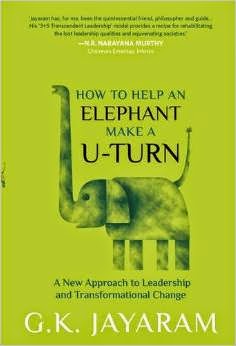
How to help an Elephant Make a U-Turn

Book Review


How to help an Elephant Make A U-turn – a new approach to leadership and transformational change, G.K. Jayaram, Maven / Rupa, 258 pages


Dear Jaya,

I am taking the liberty of calling you by your first name – since in the ‘’author’s note’’ you invited the reader to ‘talk to you’ (over a mellow drink, at that) rather than simply ‘read’ the book.  Actually – that’s a novel (pun intended) way to have a lesson on leadership and I quite like your style.

I picked you up (no pun intended there) at the Higginbotham’s in Chennai Airport during a long layover between flights.  Over the years I have become a bit wary of books on leadership – with practically every other superannuated executive turning into a leadership coach and writing a book. Much of what they write –  to twist one of your quotes – works neither in practice nor in theory.  But, the green jacket held my attention and what caught my eye were the words “Transformational Change”.  Flipping the pages I found myself being seduced by another term “transcendental leadership’’. So, is this guy talking of personal transformation as a key to change and leadership? – I asked myself and there you got me hooked.

I was fascinated by the concept of RORE – ‘revolution of rising expectation’. What could be more relevant for a country of young people like ours waiting to break free in the world. It is truly an empowered generation with a mind of their own, who believe in their abilities and think they are not less than equal to anyone – what you call PROBE ( Promise in and Belief of Equality). The challenge, therefore, is as much for the business or corporate leader  - as it is for the societal and political leadership – in how to harness this energy, transcend the past as also the immediate and practical (pragmatic) to create transformational change.

I am glad that you have taken the concept beyond the narrow and limited framework of corporate organisation to society at large – because the issues facing leaders dealing with a young restless professionals who see sky as the limit or the small town graduate coming from an humble homes  - no longer recognise any sense of ‘’entitlement” and want to reach the top solely on merit and by dint of their hard work.

Today’s leaders must recognise this tectonic shift (to use a cliché) in attitude and aspirations – otherwise they risk losing talent in organisations just as the old world politicians will find themselves hopelessly disconnected from the ‘gen-next’ voters.
Frankly – I don’t care much for the testimonials and interviews you have laced the book with. To be blunt – they came across to me as your ‘’Infy’’ Groupies or the Bangalore Club cronies – who intrude into our quiet chat at the Bar. Over-laden with the quotes and excerpts from other leadership and management classics the so called “Leader-Speak”  were a distraction. But, I thought it was a great idea to bring in contemporary examples of the Anna movement and the infamous fall of the Indian ‘poster-boy’ of corporate America to bring home the importance of integrity, intensity and imagination in your  3 + 5 Model of Transcendental Leadership.

It’s easy to understand – why Narayana Murthy calls you the “quintessential, friend, philosopher and guide”. I can relate to you as one – virtually – even not having met you in person.

Warmly,

Sandip

PS: Hope you have gifted an autographed copy to the Prime Minister. The subject would be right up his street. And, even young Arvind Kejriwal – could do with one so that he can “transcend’’  the past mistakes of his own and that of his former mentor  – that you so graphically describe in the book – and move on to a higher order of transformational leadership.

Article first published in Business Today issue April 12, 2015

Monday, August 15, 2011

Jai ho !!

It would be interesting to see how the show-down between the Government and the ‘civil activists’ pan out in the coming days. Will the government with its spin machinery and administrative might manage to scuttle it – like they succeeded in the case of Ramdev or will it fizzle out under the weight of their own inner contradictions, rifts and cracks that may open up thru’ the ruling party’s backdoor machinations ?

Some felt the movement may have lost steam in the long interregnum. I feel it's only gathered momentum. I was quite surprised the other day - when our domestic, a quiet sort of a chap otherwise, said - seeing Anna on TV - "Accha aadmi hai". I asked if he would support him - pat came his emphatic reply "Karta hoon na..". I sensed the same mood travelling across the country in the last few months.

Do the Congress and UPA Government crisis-managers and spin masters genuinely think l that, by hurling accusations at Anna Hazare & Co at this 11th hour they will be able to swing public opinion against him ? They must be kidding themselves in believing that raking up a 10 year old issue of Rs 2.2 lakhs allegedly spent by the trust on his Birthday celebrations - would demolish his moral standing for leading an anti-corruption crusade.

Frankly, the public would care a damn about Rs 2.2 lakhs controversy or any other skeletons from the closet that may be taken out at the last minute by the government’s dirty tricks department. They know how crores are spent to celebrate the birthdays of political leaders and although there may be no commission of enquiry to probe where those funds come from - the people have no illusions about who actually pay for such obscene extravaganzas. So, if the villagers had decided to celebrate the birthday of the man who has so selflessly devoted his life to change their lot – by spending a couple of lakhs , it’s simply not going to cut ice with the masses at large.

And, make no mistakes – we are not talking here about the “relative scale” – lest some of you are tempted to spring the argument that no amount of corruption can be considered too small. The issue as we all realize is much larger. If the surveys conducted by the various media houses are anything to go by – the nation is seething with anger against corruption – which they have been silently suffering for so long and has now reached Himalyan dimensions – and for the time they have found a credible vehicle for expressing their dissent.

I think the Sibals, Chidambarams and Salman Khurishids are missing the woods for the trees. We Indians love symbols. And, all of us understand that Anna is just a symbol for a much larger cause. Any other person in his place – say, an Arvind Kejriwal or a Kiran Bedi – would NOT have captured the imagination of the people in the way Anna has been able to with his beatific smile, Gandhian attire and the almost saintly simplicity and directness of his communication – which easily understood by the lowest common denominator, sans the rhetoric and intellectualisation of the establishment spokes persons or even his own compatriots. On the other hand, Ramdev’s credibility and integrity was suspect from the beginning. He had always had a huge set of detractors and skeptics who doubted both his antecedents and claims. It’s reasonable to believe that, he had been propped up by the government and, in the end , became victim of his own charlatan tricks.

But, the situation with Anna is far more tricky as the government had learnt in the first round itself. Thereafter, they had thought - trying to be clever by half – that they would trap them in the committee but had probably underestimated their tenacity. In their hearts – therefore, they knows it could be a ‘no win’ situation for them – unless they are able to sabotage the movement from within – which at the moment looks difficult. Otherwise, if they crack down on the protesters – it may trigger off wide spread agitations around the country. And, if they allow the “anashan” to continue – it has the potential of bringing the government tumbling. So, in a way they are faced with a Hobson’s choice – a mess they have only themselves to blame for.

I don’t also buy the argument that – in a parliamentary democracy one should have to come only through an ‘electoral” route. If that was true no popular movement – would have happened in any country. It is the very argument of corruption that goes against this logic. Strangely some of our intellectuals and political pundits seem to be supporting such a view. From their tweets and articles – denigrating any ‘extra-parliamentary’ movement, it would almost appear that they would prefer corruption to continue than any destabilization of life in the capital. With cost of elections being what they are today (in states like Maharashtra and Karnataka – a Loksabha ticket is rumoured to cost upwards of Rs 30 crores) – would any “civil” representative ever contest an election without being corrupt ? It’s laughable that, ministers are questioning the funding behind these agitations – would they care to explain how political rallies are conducted. Young Manish Tiwari - in his obvious eagerness to impress the first family - sounds like a modern day Goebbels when he says that, Team Anna is corrupt from “top to bottom”.

True the Lokpal may not be the panacea or “magic bullet”, to borrow a term from the colourful vocabulary of our articulate Prime Minister’s men – but it would , at least, drive the fear of God among our rulers to – if nothing else – temper their greed to a more "human" level, from the diabolical proportions it seemed to have reached now.

Long live the republic. Jai ho !!