Showing posts with label Management. Show all posts

Tuesday, October 04, 2016

Is trust over-rated at the workplace ?

Trust begins with one's own self


Pic from Net


Article first published in +Medium Click here


Trust as a function of leadership — is a current flavour of the season. It is not really a new concept or discovery. But, as in life so in organisations ideas keep coming back. There is, probably, a larger existential reason for it. Over time – values wither to a point of being dysfunctional – that is when nature’s own correction mechanism sets in to restore balance.
Corporate culture was never selfless. Dog eat dog is an old adage. Far from eschewing canine meat in favour of healthier alternatives — the pressures of quarterly results and investors breathing hot air through the ducts of the Boardroom have made organisations more ruthless. Consequently. – professional shelf-lives are shrinking putting ambitious youngsters on an overdrive. In an age of fitness mania – the proverbial rat-race has changed into a sprint up the stairs of a high-rise. In their frenetic rush to reach the sky – there is little time to cultivate deeper personal values for most. Andy Grove of Intel wrote “only the paranoid survive”. Doubt if by that he meant personal paranoia and insecurity — which frequently manifest among today’s C-suite executives.
The result of course is not difficult to predict – fast burn-outs, messed up personal lives and relationships, psycho-somatic ailments and personality disorders. The bottle, sedatives and in some cases substance of abuse (read drugs) are just an arm’s length away. Along the way it wrecks havoc in organisations and families.

So, where does trust come in all this ?


Pic from Net
Was chatting with an old friend and once colleague — who is hanging up his boots from active corporate life after fairly long and illustrious career — that took him quite close to the corner office but not inside one. Since this was a day after his farewell he was in a somewhat reflective mood. In the past 30 years our professional paths had crossed a few times and we did travel together as co-farers on the some stretched of the lonely road. Therefore, we had several data-points to exchange.
We talked of leaders we both admired and even those we did not — despite, in some cases, their truly outstanding successes. We also discussed colleagues — some who had moved ahead and others who were left behind or remained stuck. He shared a few recent snippets — that left me a trifle disturbed as it briefly shattered the image I had of some people. That led me to ponder over worlds like trust, betrayal, loyalty and gratitude.

Here are a few jottings in no particular order of importance:


  1. Trust is what everyone expects from people but not many are able to place it on others;
  2. Both developing trust and feeling the need to trust (others) comes with age and (life) experience; As we grow older — the illusions of invincibility get toned down and we become aware not just of our limitations but also — albeit at a sub conscious level — mortality. But, those with higher Emotional Intelligence tend to mature faster and realise that these softer human values are the true and enduring differentiators of leadership.
  3. Like most human traits — trust is part nature and part nurture. It is important to strike a balance between the two. Sometimes nature has to be corrected or compensated by nurture;
  4. Don’t be naive; But, don’t be cynical either. And, certainly don’t become bitter if let down or betrayed by someone you trusted;
  5. Do not expect anything in return from trusting people; Most importantly do not look for loyalty from people you trust. People are loyal to their needs and not to individuals;
  6. The rewards of trust does not come by way of gratitude or even accomplishment — but through internal growth that takes one to the next level of self-actualisation;
  7. Not everyone can bear the burden of gratitude; Being grateful requires genuine strength of character — to accept one’s own vulnerability and weakness which is not easy;
  8. Remember the number of times others have trusted you unilaterally; how that made you feel and how it shaped your attitude towards them; How often did you go back to thank them?
  9. Trust is not weakness it is means strength; It is about taking risks, making mistakes and preparedness to accept failure (for trusting the wrong person); That is the hall mark of true leaders — that sets apart the stars in a crowd of wannabes and losers.
  10. Never look back — if you trust someone and he/she has delivered say ‘thank you’ and move on.; if they have failed to deliver despite best efforts — say thank you all the more and if they have betrayed or let you down — buy them a drink as in the process made you wiser and a better human being;

Finally, trust is all about us. Before trusting others we must learn to love and trust our own self. Once we are able to do that — the rest becomes easy. Does not matter if those you once trusted think you are hallucinating — because the joke will then be on them.

#Trust #Leadership #Gratitude #Coaching #Psychology

Tuesday, September 27, 2016

The Emami Gurukul


Book Review: Business the Emami Way

Article first published +BusinessToday Click here 


As a child one heard of an allegorical tale of a village barber. He used to carry out minor surgeries for the villagers. Then came along a crafty quack who said to the barber: "You are so naturally gifted; now if only you had a formal training you could become a top surgeon." The simple barber swallowed the bait and asked the quack to teach him. And that was the end of his practice. Each time he picked up the implements he got scared at the thought of what could go wrong. He could no longer trust his intuition and native skills; the burden of medical theory paralysed his craft. Reading Business The Emami Way reminds me of that fictional barber - for reasons I shall come to in a bit.


R.S. Agarwal and R.S. Goenka are the stuff legends are made of. They are phenomenal entrepreneurs who started small by moonlighting while still working for one of the largest industrial groups. From there, they went on to build an empire taking on formidable FMCG multinational giants. They did with FMCG personal care products what Karsanbhai Patel of Nirma achieved with detergents; then gradually expanded into other FMCG categories like edible oils and retail pharmacy chains. To deploy the surplus of the low capital intensity consumer products business, Emami made lateral forays through joint ventures into healthcare and real estate. Nirma had, on the other hand, ploughed back its cash for upstream industries like Soda Ash and Linear Alkyl Benzene. It may not be sheer coincidence that both Nirma and Emami will soon be battling it out in the cement markets of Eastern India.

What could have been an enthralling saga of their fascinating journey from bean counters to business tycoons - gleaning management and life lessons along the way - has been marred by adopting a guru-shishya dialogue format. The "gyan" that is dispensed may sound to an evolved reader rather elementary, often laced with cliches and time-worn quotes like "Time and tide waits for no one". On how to conduct effective meetings, it is advised that "secretaries of the top bosses should collect all related facts and information for the department or departments and present it before the bosses". To check interruptions, it is suggested the boss hang a 'Do Not Disturb' sign outside his office. But if friends drop in announced, one needs to make time for them (so as not to appear "downright impolite"), but "do not go overboard".


Discourse about market segmentation, socio-economic classification and attitudinal difference between rural and urban consumers are in the same simplistic vein. But, all of it is grounded in strong earthy wisdom, cutting the chase - which is something professional managers and fledgling entrepreneurs can imbibe from the Agarwal-Goenka Gurukul.

The most interesting part of the book lies in "a leaf from my life's book" at the end of each chapter, which by itself could have been a rich read if chronicled in some more detail and depth. There was, perhaps, no need to laboriously plod through management theories like teaching human anatomy to the barber.

Wednesday, July 27, 2016

How ITC reinvented itself to “a company that also makes cigarettes”


Aricle first published in +Mint Click here to read


Over a decade ago, one of the doyens of Indian business journalism had written an article, “Tale of two companies”, comparing two packaged consumer goods makers — Hindustan Lever Ltd (still not Hindustan Unilever Ltd (HUL) then) and ITC Ltd. Since then much soap and detergent have been washed down the Hooghly and Arabian Sea — as indeed millions of puffs have been blown through human chimneys. While HUL has regained its old act by re-engineering itself, ITC has got its new act together by reinventing itself.

Till the early 1990s, the punch line of all Hindustan Lever chairmen used to be “we are an Indian company whose largest shareholder happens to be a multinational”. ITC, on the other hand, used to be less apologetic about its BAT Plc. parentage. Following the eminently forgettable K.L. Chugh era, when Y.C. Deveshwar mounted the saddle, in a corporate coup of sorts with the backing of institutional shareholders, he decisively cut off the umbilical chord and embarked on a mission to establish ITC’s Indian credentials with a vengeance.

At the same time, with liberalization of the Indian economy, the new generation chairmen of Lever over time shed their trademark khadi silk bush-shirts in favour of bespoke suits when traversing the power corridors of Delhi. However, this piece is not about comparing the two companies but trace the evolution of ITC as an Indian consumer products giant.

It is easy to surmise why Ajit Haksar — the last of the corporate Mohicans — ventured into hotels. It was partly to hedge against the possibility of curbs on the tobacco business and also as a safe haven for the surplus funds of the mother business that could be easily encashed anytime by selling the brand or the real estate. It is to Haksar and ITC’s credit that they nurtured Welcomgroup for a long time before it became truly profitable. Printing and packaging (where Deveshwar first cut his teeth) and paper boards were but logical vertical integration.

Similarly, one would believe the lifestyle and apparel business was started to secure the Wills franchise. But the real serious diversification was kicked off with ITC’s plunge into the foods business — which arose both out of necessity and opportunity. Subsequently, it naturally extended to pure consumer products play.

The story of ITC’s transformation is one of turning a proverbial threat into an opportunity. As the time-worn cliché goes — cigarettes is a “dying” industry in more senses than one. With the intervention of World Health Organization and a judiciary increasingly sensitive to the hazards of tobacco consumption, the tobacco industry has had to brace itself for a premature sunset like its consumers (smokers).

Simultaneously, there was a need to divert public attention from corporate governance and health (tobacco) to being a socially-responsible organization. This, one would suspect, was the genesis of a “we also make cigarettes” strategy.

The ban on cigarette advertising came as a blessing in disguise as it left ITC flush with cash. Not having a majority foreign shareholding allowed it to enter the food sector — then reserved for domestic players (except those such as Nestle SA, GlaxoSmithKline PLC and a few others — who enjoyed the benefits of a “grandfather” clause). Food was largely an open field with no organized pan-India player barring Britannia Industries Ltd. From biscuits, atta, ready-to-cook or heat meals, it has seamlessly moved to instant noodles, juices and now, one hears, coffee is in the pipeline.

For a cigarette manufacturer with low technology and little product innovation except in packaging perhaps, ITC’s most remarkable achievement was in learning the ropes of an entirely different supply chain and gaining mastery of a new product category, not just in terms of marketing but product development and innovation. Equally challenging was building a network which — contrary to popular belief — had little in common with the cigarette retail channel.

The evolution into personal care was even more interesting because here it had to contend with a giant like Unilever with an 80-year legacy in India, international brands and world-class research and development. Making soaps, body-wash and shampoo brands is as different as paneer is from talcum powder. Globally, too, it is rare for companies to be equally successful in both food and packaged consumer products. Neither Unilever nor Procter & Gamble Co. can really be considered to have handled both businesses with the same level of success while traditional food makers like Nestle and General Foods Corp. have by and large stuck to their knitting.

However, ITC’s real success lies in achieving this transformation with existing, home-grown talent with very little (or practically no) lateral hires at senior levels. ITC remains one of the few large companies that still believes in providing long-term careers to its employees. It is a key differentiator in a fast-changing corporate world where “turnover” and “velocity” are the current flavours of human resources management. Changing the corporate DNA and culture is no mean task. If an organization has to reinvent itself so have to its leaders. This is where Deveshwar scores above many of our present day corporate icons. Arguably, he had an extended stay at the top. But Deveshwar leaves behind a new ITC for the next generation.

In contrast, the much-hyped “Project Millennium” of Lever — riding on which many careers were made — lost steam. Among close to a dozen business ideas incubated — just about one (water, that too in a modified form) has survived the genetic implant.

It was generous of Deveshwar to praise Amul and Patanjali in his speech.The jury on the latter is still out. But, what it does underscore is the rapidly shrinking ramp-up time. What took Unilever 60 years to achieve, Amul did in 40 and ITC in 20. Now, Patanjali has managed to scale up in less than five.
A fascinating battle lies ahead between the global giants and the emerging “swadeshi” challengers.

Sunday, March 20, 2016

Toxic Bosses

Prologue: A passing mention of "Toxic Bosses" in my previous blog-post "Depression is not a common-cold of the Mind" - triggered a lot of reactions among friends and readers. Many wrote to say, the article had resonated with them and they could empathise with the individual and the situation - understanding where I was coming from, so to speak. Among them were also few former colleagues - who were upset thinking it was a veiled insinuation at a certain individual - who is their current boss and whom they obviously held in great esteem - and rose to the person's defence with rejoinders. One of them said, it's unfair to blame a boss for one's own lack "Managing Up" competency - something the correspondent must be obviously good at considering the alacrity of response in 'standing-up' impromptu for the boss.


This article was, however, conceived and written much before that. For a long time, I have been contemplating doing a series on Organisation and Leadership Issues from a practising manager's perspective. Having worked across industries for over 30 years now - I thought there may be a few insights to offer and experiences to share that may be of interest to the younger generation as they make their way through the labyrinth of modern VUCA organisations - which are full of ambiguity and uncertainty - with few to hold their hand through the journey. Recently, I did an obituary of a marketing doyen who passed away - under whom I had the privilege of working in the so-called "nappy days" of my career. A close comrade, who happened to like that piece and an older one on another "Management Guru" suggested I do profiles of some remarkable people (the great, the good and the ugly) one had worked with and cull out leadership lessons from them.


Here's a modest and tentative beginning - hopefully, it will fall into the groove in the coming weeks after a few more pieces. I crave your indulgence, candid feedback and critique


Prozac is not the answer


One seldom likes the boss.


In a long career – there are only a few bosses one really comes to love. But, equally there are not many one who actually hates. Even if one didn’t enjoy working under some of them- over time the dislike wanes and one is able to understand where they were coming from and accept as human beings with their own set of failings and limitations.  Only a few leave a deep scar that doesn’t go away easily and one finds difficult to forget or forgive them even after many years.


Contrary to popular perception a toxic boss needn’t always be loud and rude. In fact, Type A personalities are often not toxic at all. Their volatility and temper tantrums are usually enough to burn up the pent up aflatoxins in the system. Similarly, hard taskmasters and workaholic bosses – though painful and taxing to work for – aren’t necessarily venomous. In fact, Toxic Bosses (let’s call them TBs) needn’t fit into any traditional boss stereotypes at all. They come in various avatars.


There is one common and essential characteristic of TBs – they unfailingly damage (and in extreme cases destroy) the self-esteem of their subordinates and teams. There are multiple ways TBs work on this – the commonest being making people below feel insecure and inadequate – being unjustly critical of their work and unappreciative of contributions. In extreme situations, this could even take the form of personal humiliation. Appropriating or denying credit for work done by juniors is second nature to TBs.


In all cases – their behaviour is underscored by a lack of respect for people, which goes against the grain of professionalism and basic human values. By nature, TBs are distrustful of others (except the odd sycophant – even their utility is time bound and come with ‘best before’ dates – unless there are secrets to keep) and don’t let others get comfortable around them. TBs are adept at the “Lick and Kick” game   – ‘lick’ the bosses and ‘kick’ the subordinate.


It is a given that TBs are supremely selfish and have no qualms of treating people as Tea bags (‘use and throw’). That also makes them manipulative. But, the problem is not as much in ‘using’ as it is in making them feel ‘used’. A smart leader – also uses people but make employees feel rewarded. It’s famously said of an iconic CEO of one of the oldest MNCs in India – people came out grinning from his room looking as if they have got a raise or bonus – when actually he just doubled their target.


By definition TBs are not transparent in their dealings. But, sometimes they can make it work to their advantage by coming across as extremely suave – especially to external stakeholders carefully cloaking their vicious element under a veneer of sophistication. These are the more dangerous of the species – who often also have integrity problems – both intellectual and financial.


Behavioural experts can reason – TBs are products of a deeply insecure psyche. Some may even attribute it to troubled childhood – which makes them the way they are. There will always be the “nature vs. nurture” debate and without doubt upbringing and formative experiences have a significant impact in shaping personality and leadership styles. However, at a more basic level they are afflicted by supreme ambition not backed by commensurate competencies. TBs are acutely aware of the fact that they have reached where they are not by merit but either by accident or manipulation. This makes them deeply anxious, as they know fortune does not always favour the creep – they fall back on machinations at the cost of their minions and organizational health.


So how does one deal with toxic bosses? Many wise men will advise – it is ‘Karma’ - so “what can’t be cured must be endured”. While that might be true to an extent – a fatalistic “surrender” is not the answer and may actually compound the misery. Sneaking on the boss – even TBs – never work in a corporate culture and bitching is even worse as word inevitably gets around. One can safely assume that if a person has reached a certain level in an organization – his own bosses can’t be blind to his style of functioning. If they are still allowing him to continue (despite feedback or 360 degree appraisals) somewhere the assets in his “professional” balanced scorecard still weighs over the negatives. With organizations themselves becoming more and more myopic in their outlook (notwithstanding what Management literature might advocate) – when the next quarter determines the CEOs fortunes - there is premium on short-term delivery. Unfortunate but true – not many of today’s star CEOs care more about their own shooting careers than sinking organizational morale. Nothing succeeds like success, they say in the corporate world. Therefore, usually – it is equally pointless – to take up “boss-subordinate” relationship with HR – unless there is a genuine case of “harassment” – sexual or mental.


The first principle is to ‘push-back’ – but in a polished professional and dignified manner (sometime putting responses on mails help – as it does keep a trail). Bullies usually tend to back off if challenged – just as they see submission as a sign of vulnerability and weakness. The important message to be conveyed – preferably right at the start (the ancient adage – of killing the cat on the first night) – is you are the master of your own destiny and not willing to hand-over its reins to anyone else – no matter how powerful he or she may be. Thereafter, it’s best to negotiate the terms of engagement and stick to them steadfastly - bringing the dealings back on track whenever they tend to stray off course.  And. always without fail claim and record credit for good work. Another good strategy, is to gain visibility outside one’s own Department with other functions and members of the senior leadership team. This can sometime provide an insurance cover against unilateral actions of a devious boss.


But, the real trick is not to allow the boss get under the skin and start affecting emotional wellbeing. For this, personal techniques – be it counting 10 before responding or meditation – are handy tools. But, if the going gets tough seeking coaching or counselling is an option worth considering. Techniques like CBT (Cognitive Behaviour Therapy) can do wonders.


Finally – much as old timers will say – “You can’t hose your father or your boss” – one always has the option of leaving them. But, do it at a time of one’s own choosing – not forced by the boss or cracking down under pressure. Nothing riles a TB more than someone pulling the plug off him without notice by a sort and sweet resignation letter.


That of course, is the last resort. But, there’s no job worth sacrificing one’s health – mental or physical – no matter what may be the financial compulsions. I have done it myself a couple of times in the last 30 years and never had to regret it. The sense of “liberation” one feels after exercising the ‘choice’ of freedom – has to be experienced to be believed.


Article first published in @hrkatha.com click here to read


Friday, March 27, 2015

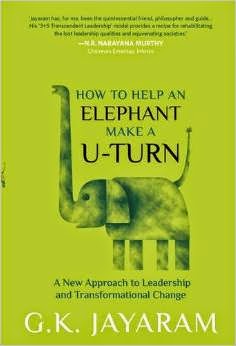
How to help an Elephant Make a U-Turn

Book Review


How to help an Elephant Make A U-turn – a new approach to leadership and transformational change, G.K. Jayaram, Maven / Rupa, 258 pages


Dear Jaya,

I am taking the liberty of calling you by your first name – since in the ‘’author’s note’’ you invited the reader to ‘talk to you’ (over a mellow drink, at that) rather than simply ‘read’ the book.  Actually – that’s a novel (pun intended) way to have a lesson on leadership and I quite like your style.

I picked you up (no pun intended there) at the Higginbotham’s in Chennai Airport during a long layover between flights.  Over the years I have become a bit wary of books on leadership – with practically every other superannuated executive turning into a leadership coach and writing a book. Much of what they write –  to twist one of your quotes – works neither in practice nor in theory.  But, the green jacket held my attention and what caught my eye were the words “Transformational Change”.  Flipping the pages I found myself being seduced by another term “transcendental leadership’’. So, is this guy talking of personal transformation as a key to change and leadership? – I asked myself and there you got me hooked.

I was fascinated by the concept of RORE – ‘revolution of rising expectation’. What could be more relevant for a country of young people like ours waiting to break free in the world. It is truly an empowered generation with a mind of their own, who believe in their abilities and think they are not less than equal to anyone – what you call PROBE ( Promise in and Belief of Equality). The challenge, therefore, is as much for the business or corporate leader  - as it is for the societal and political leadership – in how to harness this energy, transcend the past as also the immediate and practical (pragmatic) to create transformational change.

I am glad that you have taken the concept beyond the narrow and limited framework of corporate organisation to society at large – because the issues facing leaders dealing with a young restless professionals who see sky as the limit or the small town graduate coming from an humble homes  - no longer recognise any sense of ‘’entitlement” and want to reach the top solely on merit and by dint of their hard work.

Today’s leaders must recognise this tectonic shift (to use a cliché) in attitude and aspirations – otherwise they risk losing talent in organisations just as the old world politicians will find themselves hopelessly disconnected from the ‘gen-next’ voters.
Frankly – I don’t care much for the testimonials and interviews you have laced the book with. To be blunt – they came across to me as your ‘’Infy’’ Groupies or the Bangalore Club cronies – who intrude into our quiet chat at the Bar. Over-laden with the quotes and excerpts from other leadership and management classics the so called “Leader-Speak”  were a distraction. But, I thought it was a great idea to bring in contemporary examples of the Anna movement and the infamous fall of the Indian ‘poster-boy’ of corporate America to bring home the importance of integrity, intensity and imagination in your  3 + 5 Model of Transcendental Leadership.

It’s easy to understand – why Narayana Murthy calls you the “quintessential, friend, philosopher and guide”. I can relate to you as one – virtually – even not having met you in person.

Warmly,

Sandip

PS: Hope you have gifted an autographed copy to the Prime Minister. The subject would be right up his street. And, even young Arvind Kejriwal – could do with one so that he can “transcend’’  the past mistakes of his own and that of his former mentor  – that you so graphically describe in the book – and move on to a higher order of transformational leadership.

Article first published in Business Today issue April 12, 2015