
Neil Bose – my friend in college, a bright student otherwise – failed to get a first class in his Economics Honours. Calcutta University, of course, applied standards of evaluation that could easily make an Oxford Don stumble. Disheartened and disgusted with our examination system, Neil threatened to write a guide-book on “How to get a First Class – written by a ‘Second Class’ student”.
It’s an old adage – “those who can do, and those who can’t teach”. A great teacher need not necessarily have been a brilliant student – though, there is nothing to prevent it from being the other way round. The same true not just in academics but also in other fields of life – especially sports or music. Some of the best sports coaches - weren’t the champions of the game. Very often – in their own careers they fell short of reaching the top – despite being hugely talented. Chances are – they didn’t get the lucky breaks – but more likely they weren’t temperamentally cut-out for making it big. It is from their failures though they learnt the rules and tricks of success – which they could put to use good use in training others.
Old Boys' Badge Value
Executive Coaching – popular abroad, especially in the US, for quite some time - is catching on India like so many other western fads. Many former senior colleagues connecting on Linked-In and Facebook mention “Executive Coach” as their current occupation. Most of these are glorified announcements of “disguised unemployment”, but still some, I am told, have made a successful practice of it – adding handsomely to the generous superannuation package endowed in their favour by past employers. They largely rely on word of mouth recommendations of friends – much the same way they land on company board memberships through ‘old boys’ network.
Like external directors how much value they really add – is questionable. Only a few amongst them have actually undergone any kind of formal training or have an accreditation for coaching. Many don’t even have a HR or Organisation Behaviour (OB) background. A coach is supposed to operate somewhere between a mentor and a therapist. It requires certain skill sets and competencies like any other profession. These people generally don’t have any such specialization and fly by the seat of their pants. But, still they do have takers.
First, there is a badge value. It’s fashionable to have an executive coach these days – if you are seen to be a high-flyer within the organization. It’s almost like the craze among the rich, famous, yuppies and wannabes for personal trainers at their private gyms. A friend in the HR circuit educated me, it’s a ‘win-win’ formula. Earlier, companies would send their ‘hi-po’s for professional development or advanced management programmes to top management schools. Now, if you are of an employee of any value – it is difficult for an organization to spare you even for a couple of weeks to attend courses. And, even if they do – the incumbent is scared if he or she’d have a job upon return. For this – appointing a coach is a convenient solution. It probably costs as much or less than an external programme and the coachee doesn’t have to take time off from his or her job. Following a round of coaching and mentoring, there are usually some visible behavioural changes, which get reflected in 360 degree appraisals, at least in the short-term, that makes everyone – the boss, the sub-ordinate, his reports and peers – happy, setting in motion a self-fulfilling virtuous cycle.
a susegad after-life
If you have been wondering – where I am leading you to with all this circumlocution, it’s about alternative vocation options, something that I have been pondering over for a long time. There are only a few people I know, who have been able to make a successful career in mid-life or later. It’s not easy to re-invent one-self. Re-skilling is one of the most difficult tasks – though we may not always realize it. Displaced populations – land losers especially – realize it at the hard way. But, this is the “
Age of Unreason” – Charles Handy, the Oil Company Executive turned management Guru and Corporate Philosopher had written about. It’s a modern day challenge to prepare for that day of reckoning – otherwise, we are left holding an “
Empty Rain-Coat” – to use another Handy title – shorn of our corporate trappings.
Of course, a susegad (socegado) life in Goa would be what the doctor ordered for me. But, even my young daughter refuses to take me seriously when I talk about it. A moderate climate hill-station like Coonoor would have been good too. But, these places are fast getting crowded and running out of basic necessities like water. The bigger question, however, is having neither a hefty retirement corpus nor any other source of annuity - how will I sustain myself. The cost of medical treatment itself is frightening.
Using the same convoluted Bosean logic ( Neil, no relation of the now famous D K Bose), I think - I would have made a decent Corporate Coach (among so many other things) if only I had taken the pains to archive and chronicle all my mistakes and failures in corporate life. Coming to think of it – I have learnt more from bad bosses – some of them, of the Hari Sadu variety - than the ones for whom I loved to work. But, alas I don’t have either the network of contacts or the gravitas. A friend suggested that, a way to overcome the latter could be by getting into tele-coaching – where the coachee would not be able to see me. It seems – the client opens up more when he is not sitting under the glare of the coach or mentor in a chair or a couch – but instead relaxing on his potty or lying in bed with just undies on - scratching his front or back as a thought stimulator. Somehow, it sounds like being a corporate phone gigolo and doesn’t quite appeal to my finer sensibilities.
So my quest – for a corporate ‘after-life” continues. Till then, my downhill slide from one soul breaking job to another is ordained to continue – soaps and shampoos to sanitary napkins and diapers; (news)paper to concrete, as it were.
Any suggestions are most welcome !!



 Yet, as the poet wrote, we travel the world but overlook the
beauty at our own back-yard. As a Bengali, I am ashamed to admit that I have
never been to the Sunderbans – partly because till recently no infrastructure
worth its name existed there. I am told
now a few Eco Resorts have come up – which aren’t too bad. Monsoons are certainly not the time to go
there. But, I hope to make amends this winter and wade through a few pages of
Amitav Ghosh’ The Hungry Tide.
Yet, as the poet wrote, we travel the world but overlook the
beauty at our own back-yard. As a Bengali, I am ashamed to admit that I have
never been to the Sunderbans – partly because till recently no infrastructure
worth its name existed there. I am told
now a few Eco Resorts have come up – which aren’t too bad. Monsoons are certainly not the time to go
there. But, I hope to make amends this winter and wade through a few pages of
Amitav Ghosh’ The Hungry Tide. 
 The Bengalis called it “change” for short – meaning a change of weather and place. They’d say - “change e jacchi” – literally, going for a change (sic) - “Ektu jal, hawaa badal korey aashi”. So, in winters they’d move base to what was colloquially referred to as the “West” (Paschim) – small towns of Bihar (now Jharkahnd) - Deoghar, Madhupur, Hazaribagh, Ranchi – sometime even as far as Banaras. In summers – it would be to the sea-side of Puri or Gopalpur (Ganjam, Orissa) or to the hills in Darjeeling and Kalimpong. It was bit like the old colonial concept of shifting capital for summers or winters – or the European custom of heading out to the Riviera or the Alps. The self styled “aristocrats” had their summer or winter homes at those places. Others would re
 nt a house or have long-stay arrangements at hotels ( the more “well-to-do” in places like the BNR in Puri or The Windamere in Darjeeling). Though we were nowhere as privileged – going on long vacations was still very much the norm even in ordinary middle-class homes.
 These were not very organized or planned trips। Travelling in 2 or 3 jalopie-loads (squeezing in 6, sometimes 7 or 8 including children into the old Ambassadors and land-masters), it was like picnic on the road with its fair share of misadventures. Practically every second night we would have to find a new place to camp or pitch a virtual tent at a Circuit Houses, Forest / Dak Bunglows, PWD Rest-houses or the Guest House of a Government Undertaking – greasing the palms of the chowkidar or seeking the benefaction of the junior local officials – or at times make way into the Holiday Home of a company. Sometimes, we were lucky to be able to make use the house of someone distantly known through a relative or friend.
 to action no sooner had the luggage been dumped into the rooms. While the rice and dal (part of the dry ration and provisions that were carried) was put to boil – couple of the men would scurry to the market for vegetables (and, on a good day, country chicken - otherwise it was mostly eggs for “deem-er dalna” click here for recipe) and their evening’s quota of whiskey (Aristocrat and Black
  Knight being the preferred brands of those days) . Breakfast would almost always be of bread, boiled eggs and the mandatory banana for the kids. Lunch on the road would naturally have to be in Dhabas – but in towns we would get to ‘splurge’ at a ‘family restaurant’ ( the high points being Kwality’s or Jone Hing in Lucknow, the Niros or LMB in Jaipur – even tho’ the last mentioned was purely vegetarian – and the likes of them) or in the cafeteria of a Tourist Lodge. (For recipe of Dak Bunglow Chicken Curry Click here)
 On reaching the final station of rest, we would go about setting up a temporary home almost like new immigrants. Life would quickly fall in to a routine – be it the long walks in the mornings to the market at other end of town or the gentle trudge in the evenings to the Military Farm Dairy to get cream for the strawberries. We would very soon be on familiar terms with not just the local grocer and baker – but, at times, even the best tailor of the place from whom – for some inexplicable reason – my uncle decided to order a suit and had to make umpteen rounds to get the fit exactly right. In the process, the rest of us too – including the ladies - had some piece of winter clothing stitched from him. On the weekly trips for encashing Travellers’ Cheques ( a
 s there were no Credit Cards or ATMs then) – the Bank Manager – would not only give us sight-seeing tips but also, occasionally, share little nuggets of gossip about celebrities who would come for escapades to some tranquil hide-outs in the vicinity. . Before long, it would be time to leave and we would go about bidding farewell with a promise to come back soon – which, at least for then, were meant genuinely.
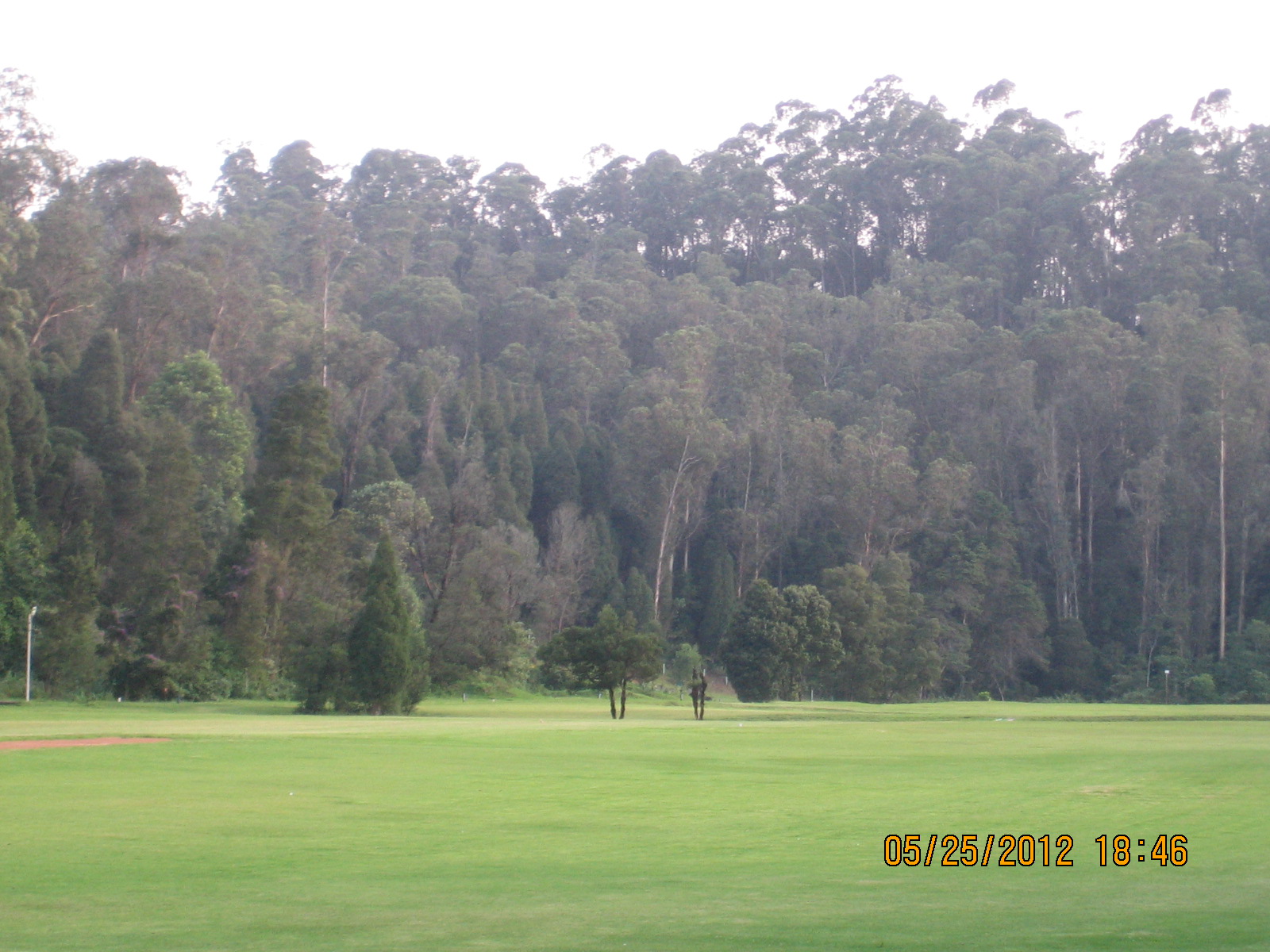
 One such holiday – we had enjoyed a lot was in Ooty circa 1973. Took my father there – at the end of our trip to Wellington, Coonoor, earlier this month - after a gap of nearly 37 years. It wasn’t such a good idea – because, within 3 months of my Mother’s passing away, it only brought back for him a flood of old memories. We drove down Havelock Road to see the house where we had stayed (that belonged to a leading stevedore of Madras). It was now in shambles and a slum had sprung up around it. Shinkows – which, I believe, is not a patch of its old self - was shut for renovation. Among the o
 ld shops only Chellaram’s had retained some of its old character – Mohan’s was now like any other touristy shop at a hill station. Charing Cross could easily pass off as a junction in T Nagar, Chennai. Everything else – not surprisingly – had changed beyond recognition with the exception of a few tucked away secrets like the King’s Cliff. What we could manage for him was a panoramic photograph of Ooty shot in the 70s from Elk Hill mounted on the wall of the reception at the Ooty Club – which itself had stood still in time.
