Showing posts with label Political Dynasties. Show all posts

Tuesday, October 11, 2016

PV Narasimha Rao - PM of Destiny

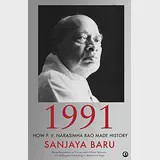
Just finished reading Sanjaya Baru’s new book — on 1991 and P V Narasimha Rao. (Article first published in +Medium click here to read)


In an increasingly polarised (and biased) world of journalism — Baru is from a fast vanishing tribe, who are able to keep facts separate from opinions and loyalties. He is one of the remaining few — who believe in research and corroboration through reading and interviews and do not pass off anecdotal evidence (read gossip) as “inside knowledge”.

Being an economic journalist and a seasoned political observer — Baru was particularly well placed to write this book that is as much about Narasimha Rao as it is regarding the economic watershed in India’s post-independence history. 1991 could have been a turning point for Indian politics as well had the Dynasty not struck back with vengeance — reducing PVNR from a man of destiny to a footnote in history.

It is divine retribution, perhaps, that after 25 years — there is a reassessment of his contribution restoring in small measure his rightful place as one who has significantly steered the country onto a new trajectory despite odds.

I have already tweeted a lot of snippets from the book as I was reading it. It is a serious chronicle of a very important period that may not interest a lay reader looking for juicy tidbits of the PVNR years. Therefore, it may not become a best-seller like his previous book The Accidental Prime Minister — which had a lot of ‘masala’ as it were. But, this is serious stuff for the archives.

Finally — the question that I was left with when I put down the book — was a counter-factual one: Where would India have been today — if it did not have the Nehru — Gandhi Dynasty ruling it (directly or via proxy) for the better part of 70 years ? My simplistic conjecture in hindsight are as follows:

If Patel or someone other than Nehru had become the first Prime Minister — it is most likely he would have still followed the Soviet model of Planned Development with a dominance of Public Sector, while paying lip service to the concept of Mixed Economy. But, where they would have most likely differed is on Nehru’s policy on Kashmir and China and probably not made the same mistakes.

Besides, we would have seen stricter enforcement of both economic legislation as well as general law and order in the country — arguably with lesser corruption. Most importantly — as PM they would have been the “first among equals” and not created a cult like Nehru — to lay the seeds of four generations of Dynastic Rule to follow.

One common thread in Baru’s recent works — are two Congress Prime Ministers, who achieved whatever they did despite the Gandhi family (specifically Sonia Gandhi)’s shadow.

There is little reason to believe — if Lal Bahadur Shastri could take Pakistan head-on in 1965 — someone else in his place would not have acted similar to what Indira Gandhi did in 1971. Also, probably, there would not have been the Emergency of 1975.

Going by Baru’s account — the country would have been better off economically if guided by professional economists and not suffered from the compromises of populist policies for the survival of a single family.

Finally, just to please the Left Libs on my time-line, it might have prevented the Hindutva backlash and, therefore, the rise of a Narendra Modi.

#SanjayaBaru #PVNarasimhaRao #SoniaGandhi #NarendraModi

Sunday, June 19, 2016

What do we really know about Priyanka Gandhi ?


Click here to read original article in +DailyO India Today 


Hope Priyanka campaigns outside Amethi, Rae Bareli.
– Ghulam Nabi Azad, India Today

The clamour for Priyanka Gandhi to come to the forefront is gaining traction. “Priyanka lao, Congress bachao” — has been the refrain among Congress workers in Uttar Pradesh for quite some time now.


Of late, many well-wishers of the Congress in the media have also joined the chorus or been co-opted to endorsing the prescription. Therefore, Azad’s statement is no surprise and is part of a carefully crafted “soft launch” strategy to use a marketing parlance. Yet, it is loaded with presumptions. Let us examine.

It is believed Priyanks made Rahul agree to that disastrous interview with Arnab Goswami.
Very little is known about Priyanka Gandhi, not just to the general public, but also to large sections of Congressmen and leaders — beyond her stunning looks, charming smile, elegant cotton saris and hair-style that reminds people of her grandmother. The rest are largely impressions gathered from snippets on TV and occasional crisp sound bites — mostly while campaigning for her mother or brother in the family constituencies of Amethi and Rae Bareli.

Beyond this, her rare extended interaction with the press and public was in an interview with a high-profile news anchor some years back, which not many would have watched given the paltry viewership of English news channels in India. I remember it for two revelations. First, that she owes her excellent Hindi to Mrs Teji Bachchan — mother of Amitabh Bachchan. It was, perhaps, the only acknowledgement in many years by any Gandhi about the contribution of the Bachchans to their family. Second, her remark about why she takes her children along on constituency tours. This, for me, was a clear indication that she wants her children to also join the family political enterprise.

Everything else is largely speculation, calibrated leaks or carefully planted seeds. For example, it is said that she is a great cook and the evidence cited is the samosas and idlis she serves to the staff in her political secretariat (that could well have been made by her kitchen help or easily ordered in from Sukh Sagar).

Not much is known about her political acumen — except that she is a key member of the Gandhi family council.

It is generally believed she was the one who made Rahul Gandhi agree to that disastrous interview with Arnab Goswami on Times Now — which, by popular consensus, was the last nail in the coffin of Congress campaign for 2014 elections. If that is correct, one cannot give her high scores for political judgment and media strategy.

Also read: Prashant Kishor can’t make Congress win UP. Rahul Gandhi won’t
There are other rumours, or shall we say gossip — about her temper, mood swings and arrogance — but few dare speak of them above hushed tones.

Though it is said that, there is nothing “private” about public personalities, it would not be proper to talk about her personal life. But since she has given no definitive indication of her aversion to entering politics — it is not unfair for us to expect her to clarify her position on various allegations against the family.

Here, one is making a distinction advisedly between “family” (sasuraal) and “paternal family” (maaika) as is the custom of this country. Like she asserts with a great deal of justifiable pride, “Main Rajiv Gandhi ki beti hoon” — one would have liked to hear her say: “Robert Vadra mera pati hain” (not “Main Robert Vadra ki patni hoon” or “Main is ghar ki bahu hoon”,feminists take note) — as per Indian tradition, which the Gandhi family avers by. While Sonia Gandhi takes every opportunity to remind us she is the “daughter-in-law” of the Gandhis, we have not heard Priyanka make any such claims about being a “Vadra bahu”.

So far, there is not much of empirical evidence available on her political fungibility, except that she displays streaks of Indira Gandhi — that can be good or bad, depending on which traits one is alluding to. If by any chance, she has traces of the Emergency avatar of her grandmother, or the 1984 riots image of her father, then there is enough reason for the country to worry.

Therefore, for the present, it has got to be a pure leap of faith for Congressmen, Congress supporters, Gandhi family retainers and fan clubs alike — banking entirely on her dynastic credentials and charisma.
________________________________________
Originally published at +DailyO India Today 

Wednesday, June 01, 2016

Political Dynasties are here to stay

Political Dynasties: India's Destiny


Article first published in +ABPLIVE click here to read

On the way to the Calcutta airport – one saw huge billboards with solus pictures of Mamata Banerjee’s cherubic nephew Abhishekh – hailing him as “Man of the Match”. It was a special day – when the city’s “Red Road” – Calcutta’s equivalent of the Rajpath – was wrapped in blue carpet for the grand “oath-taking” ceremony of Banerjee’s “Ma, Maati, Manush” (people’s) Sarkar. Ironically, as the billboards announced, it also became the formal “coming-out” day of a new political dynasty.

Dynasties are not new in Indian politics or, indeed – as has been written at length to justify them – the world over. The favourite examples cited are, of course, the Kennedy and Bush families. Parallels are often also drawn with Bollywood clans like the Kapoors, just as the large business families of Birlas, Jains and the Ambanis. Various socio-psychological explanations are offered ranging from our feudal history to Darwinian principles of evolutionary anthropology. Probably, all the hypotheses are correct in parts. But, there is an essential difference about third-world political dynasties.

The Kennedys and Bushes were inheritors of a legacy. Their family reputation and clout give them a head start in the political arena. But, thereafter – they had to all fend for themselves. The same is true for actors, cricketers or people in other professions like doctors or lawyers. They get breaks or early mover advantage, but can survive in a cruel competitive world only if they have the mettle. History is replete with instances where the sons and daughters of famous parents failed to make it good because they did not possess the requisite talent. But, in politics the overriding factor that is often glossed over lies in economics.

I recall in the late nineties – the son of a former ailing politician gave up his million-dollar salary job in a top US investment bank and returned to India – ostensibly to be with his father in his last days. A noble act by any standard I thought in my naiveté – until a bureaucrat friend decided to educate me. The money he would have earned as a banker in his entire lifetime – would not even be a speck in the fortune his father had accumulated as a politician. If he was not around all the unaccounted wealth kept with ‘benami’ holders would vaporize in no time along with the secret numbers of Swiss bank accounts. That explains how the arty son of an iconic leader from an eastern state gave up the high life abroad reluctantly returned home to keep alive the party formed by his father. Similarly – the homemaker daughter of one of the richest politician in the country being drafted back to India as the heiress in waiting.

In contrast, think of the sons and grandsons of another Prime Minister – Lal Bahadur Shastri – whose sons and grandsons despite being qualified and talented did not make beyond the “also ran” in their respective parties – as they had only the grandfather’s surname to fall back upon. Examples abound of ‘netas’ who died prematurely without anointing a political heir. Their fortunes vanished in no time with the family reduced to near penury. Conversely, we have others – who were, probably, better organized in managing their finances – whose son or daughter seamlessly moved into their father’s shoes at once staking claim to their legacy in the form of a berth in the ministry (in some cases even for the Chief Minister’s chair) notwithstanding their lack of political experience and standing in the party. Three recent examples that immediately come to mind are coincidentally all from Maharashtra – though the phenomenon is by no means restricted to that “great” state alone.

Amassing a war chest has become an imperative for political survival. Down South a Lok Sabha incumbent is believed to spend anything between Rupees ten to thirty crores in each election. The bill can be a bit lower in states on the other side of the Vindhyas – but still must be a substantial sum. Then there is the on-going cost of nurturing a constituency. But, for a “neta” it is not a matter of just one constituency. To be a force to reckon with in the system he needs to have a bunch of MLAs and MPs in his/her kitty. For regional leaders the stakes are much higher – with the flock threatening to walk over the fence every other day.

However, to “own” a party requires serious money. By today’s standards the cost of fighting a state election run into several thousand crores – as we saw during the recent Tamil Nadu polls –when the two main parties were engaged in an obscene war of distributing freebies to the voters. Such extravagance may not have caught on as yet in the less affluent states like West Bengal, Assam or Odisha – but even there to simply mobilise ground support cost the parties a few hundred crores. While the cost of coming to and staying in power is high – the money required to stay afloat when out of power is no less. Unless those relegated to the opposition are able to maintain viable presence on the ground – they will in no time become irrelevant losing cadres as well as grass-root organisation. Organising a modest rally for a visiting national leader run not just into lakhs but crores.

The humongous resources required not just coming to power but also to stay in power and survive during years of exile makes any suggestion of “state-funding” of elections an impractical non-starter. Even if the Parliament and Election Commission were to come up with a formula for underwriting campaign cost – it will at best be pocket change for candidates. It may not be wrong to say – the rules changed in the early seventies during Indira Gandhi’s tenure, which ushered in the era of “privatization” of political parties. Abolition of privy purse brought many royals into politics – who soon realized that their corpus of inherited wealth would not last them beyond a couple of seasons and were quick to learn the game. This explains the conundrum of why the rich and blue-blooded also indulge in corruption – something that flummoxes innocent commoners.

The rise in sub-nationalism has led to the creation of strong regional parties practicing identity politics. As that happens – dynasty becomes imperative because without an official inheritor the parties will disintegrate and the family fortunes vanish without trace.

Therein hangs the tale of sons, daughters, sons-in-law and the odd nephew in Indian politics. Till there are radical reforms of the electoral system (not just state funding) the Dynasties are here to stay and their numbers will grow over time.