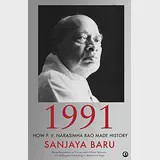
Just finished reading Sanjaya Baru’s new book — on 1991 and P V Narasimha Rao. (Article first published in +Medium click here to read)
In an increasingly polarised (and biased) world of journalism — Baru is from a fast vanishing tribe, who are able to keep facts separate from opinions and loyalties. He is one of the remaining few — who believe in research and corroboration through reading and interviews and do not pass off anecdotal evidence (read gossip) as “inside knowledge”.
Being an economic journalist and a seasoned political observer — Baru was particularly well placed to write this book that is as much about Narasimha Rao as it is regarding the economic watershed in India’s post-independence history. 1991 could have been a turning point for Indian politics as well had the Dynasty not struck back with vengeance — reducing PVNR from a man of destiny to a footnote in history.
It is divine retribution, perhaps, that after 25 years — there is a reassessment of his contribution restoring in small measure his rightful place as one who has significantly steered the country onto a new trajectory despite odds.
I have already tweeted a lot of snippets from the book as I was reading it. It is a serious chronicle of a very important period that may not interest a lay reader looking for juicy tidbits of the PVNR years. Therefore, it may not become a best-seller like his previous book The Accidental Prime Minister — which had a lot of ‘masala’ as it were. But, this is serious stuff for the archives.
Finally — the question that I was left with when I put down the book — was a counter-factual one: Where would India have been today — if it did not have the Nehru — Gandhi Dynasty ruling it (directly or via proxy) for the better part of 70 years ? My simplistic conjecture in hindsight are as follows:
If Patel or someone other than Nehru had become the first Prime Minister — it is most likely he would have still followed the Soviet model of Planned Development with a dominance of Public Sector, while paying lip service to the concept of Mixed Economy. But, where they would have most likely differed is on Nehru’s policy on Kashmir and China and probably not made the same mistakes.
Besides, we would have seen stricter enforcement of both economic legislation as well as general law and order in the country — arguably with lesser corruption. Most importantly — as PM they would have been the “first among equals” and not created a cult like Nehru — to lay the seeds of four generations of Dynastic Rule to follow.
One common thread in Baru’s recent works — are two Congress Prime Ministers, who achieved whatever they did despite the Gandhi family (specifically Sonia Gandhi)’s shadow.
There is little reason to believe — if Lal Bahadur Shastri could take Pakistan head-on in 1965 — someone else in his place would not have acted similar to what Indira Gandhi did in 1971. Also, probably, there would not have been the Emergency of 1975.
Going by Baru’s account — the country would have been better off economically if guided by professional economists and not suffered from the compromises of populist policies for the survival of a single family.
Finally, just to please the Left Libs on my time-line, it might have prevented the Hindutva backlash and, therefore, the rise of a Narendra Modi.
#SanjayaBaru #PVNarasimhaRao #SoniaGandhi #NarendraModi
Showing posts with label Nehru. Show all posts
Tuesday, October 11, 2016
Sunday, June 12, 2016
From Panchsheel to 'High Five'
Modi in US
Article first published in +ABP NEWS Click here
Is it just we Indians that lose all sense of objectivity — while judging the performance of our leaders abroad? Or does it happen only when Narendra Modi speaks to an international audience? With him — critiques and supporters — tend to ignore substance and content to focus on form, accent, pronunciation, attire and historical gaffes.
Surely Americans made fun of Bushisms, disagreed and criticized his policies — but none disrespected “The President”. The same was true for Sarkozy, perhaps. And, I am willing to bet though his “democratic” detractors may ridicule Donald Trump — should he be elected POTUS their attitude will change overnight.
I recall at an event in New Delhi in which Robert Giuliani was speaking. A British delegate from Hong Kong asked a question referring to Bush as “Rambo”. Oh boy, one had to see to believe how Giuliani tore him apart to shreds. That’s what I call national pride.
The real point to note after a speech — in my view -is neither form nor even content — but impact. This is where Modi scores above many other world leaders of the day. I am even willing to grant that — Americans are trained and programmed to clap, cheer and rise for standing ovations. Therefore, it doesn’t really matter whether they stood up 60+ times for #Modi and only 33 times for Man Mohan Singh. What really matters is how much of Modi’s speech has registered and resonated with them — what jarred, perhaps — and what was the overall perception and ultimate takeaway.
True Rajiv Gandhi also created an impression. So, would have Nehru and Indira Gandhi in the context of their times. But, a few crucial differences have emerged since then. First, the world order has changed since the end of the cold war. Just as nature abhors vacuum — a menacingly rising China is fast filling up space given away in the disintegration of the Soviet Union. But, even more significant is the rise of terror (largely Islamic) across the world. On all these scores India’s strategic importance for the US has exponentially increased.
In this revised equation — India is, arguably, the only viable entity to offer some degree of foil to China in South Asia. All other countries in the region — not just Pakistan but Bangladesh, Sri Lanka, Maldives and Myanmar would only be too willing play footsie (and, more) with China. On fighting terror — the trustworthiness of these countries — especially — Pakistan is even more suspect.
Of course, for the US — Pakistan is not wholly dispensable. If not anything — it has huge potential of damage. So despite bluffing them on Osama and acting as double agents for Taliban — the US can’t afford to dump them altogether. But, certainly Pakistan cannot hope to remain the favourite Asian nephew of the Americans.
One can justifiably argue that, any other Indian Prime Minister in Modi’s place would have also caught on to this reality and recalibrated foreign policy accordingly. But, herein lies the importance of body language and confidence.
Modi’s success lies in seizing the moment and hitting the message home. No one would have the illusion that India can claim a status of an ‘equal’ with America. But, it can certainly expect to be regarded as the “first among equals” — when it comes to America’s Asia game plan. Here Modi has played his cards eminently well and through a series of smart moves become from a “persona non-grata” to a good-friend of Barrack – even exchanging high fives in private — if some reports are to be believed.
A long way really from -the pious platitudes of Panchsheel, Non-Alignment and the “good-friends” spiel.
Monday, September 21, 2015
Why the Netaji Files are like a classic ''Bikini Act'' ?
Only the politically naive or the incorrigible romantic
nationalist would have expected anything dramatic to emerge from the 64
#NetajiFiles ‘declassified’ by the West Bengal government on Friday (18th).
It is doubtful if even the files stored in the vaults of the Prime Minister’s
Office will finally seal the mystery of Netaji’s (by now certain) death. As, Anuj Dhar, the intrepid historian who
relentlessly researched the Netaji story (and, arguably, the catalyst behind
the clamour for declassification) says – the real truth probably lies in the
records of IB and RAW, since the documents in the PMO may have been doctored to
suit a particular (Nehruvian, he suggests) line of narrative.
The story has thankfully moved on from ‘Is Netaji still alive?’
to ‘Did Netaji actually die in the air-crash?’ Fifty years ago the excitement
was around unconfirmed reports of ‘Netaji sightings’ (much like the illusory
Himalayan Yeti) – be it a photograph at Nehru’s funeral or in an Ashram in
Uttar Pradesh. The ‘believers’ (the term ‘Bhakt’ hadn’t entered the popular political
lexicon then) lived in the hope of Netaji returning from self-imposed exile to
save the country from the brink of collapse in the hands of the Nehru-Gandhi
parivar (since then, of course, we have had the advent of Narendra Modi and the
‘Netaji’ title itself has been appropriated by a Wrestler from UP). To that
extent – the debate has subsided to a more rationale plane – albeit still
emotionally and politically polarised.
What is at stake is not Netaji’s contribution to India’s
Independence - which has over the years been, by and large, comprehensively
chronicled – but whether truth about his disappearance and eventual death has
been tampered with – at the instance and to the advantage of the political lineage – that substantially took
over the reins of India post 1947.
What’s clear so far is, there was surveillance on all
members of Netaji’s family who showed the slightest political inclination – his
elder brother Sarat, nephews Amiya and Sisir till as late as early 70s. It is
pertinent to note – other than the Nehrus – the Bose’ were one of the few
significant political families of pre-independence India. While Nehru’s other
political challengers were neutralised either by design, default or (natural) death
– here was a family with educated and charismatic members who could potentially
rise to national prominence.
The Russian angle –
its veracity or lack of it notwithstanding – could be a ‘’red-herring’’ as well
- as some researchers believe. If indeed the Nehru government had confirmation
of Netaji dying in Soviet custody – it
might have suited its interest to ‘leak’ the news and put paid to the myriad
theories of his disappearance - even at the cost of scrapping the Taipei
Air-crash story.
What would have been of greater concern to the then ruling establishment – perhaps, more than Netaji’s own existence – is whether he
left behind links with foreign powers - who could be using his family members
to mount an alternative political movement – within or outside the Congress. Though in the
50s or 60s it would have been inconceivable for Netaji’s German wife or
daughter to come to India and lay claim to his political legacy (like some other foreigner spouses and their mixed
off-springs in later years) – it may not have been so farfetched for some of
his other family members to do so, especially Sisir Bose – who many considered
to be the political heir of Subhas Bose (having collaborated in his escape from
India). Coupled with this is the wide-spread speculation of stashes of INA
Funds and other treasures (like gold and
jewellery received as donations) left behind in Japan or elsewhere to which the
family may have access.
In the coming days -
till after the 50 members of the Bose family meet the Prime Minister - we shall see and hear a lot of sound and
fury in a war of spin masters. We already find ‘sarkari’ historians nurtured by
the previous regime at work and calculated plants appearing about Netaji’s
meeting with Hitler, his taking part in Mao’s revolution or helping in other
Communist uprisings in South-Asia and plans to establish ‘ruthless
dictatorship’ in India – like Tito or Mao. Interestingly, if any of these tales
turn out to be true then it would make Netaji an even larger cult figure.
Therefore, chances are, even if all the files are opened to
the public – the disclosures will still be like the
classic ‘Bikini Act’ – revealing only
what is suggestive but hiding the vital.
But, the enigma of Subhas Bose will be etched in the memory
of Indians (not just Bengalis) for a long time – as the testosterone hero of
the National Independence – a foil to the effete nationalism of Nehru.
Article first published in +DailyO India Today
Subscribe to:
Posts (Atom)


