 A hospital – no matter how plush – is not the most exciting place to spend the better part of a week. Any amount of flirting with the docile “Mallu” nurses (no offence meant – some of my best women friends have been from that southern-most region of our land) or the pretty dietician can uplift the spirit.
But, it isn't so much the after-effects of my tryst with a female of the wrong species (‘Aedes’ as distinct from ‘Anopheles’ – yes, I am down with Dengue and not Malaria !!), what I am forced to watch on prime time television every single day that's making me depressed.
…. a virgin ??
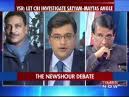 There is an unkind joke about why Christmas is not such a popular festival in Delhi. That’s because, it is difficult to find 3 wise men and a virgin in the capital city. While I have no authority to comment on the latter (tho’ not too long ago Matrimonial Columns - of what was then proudly proclaimed as Delhi’s “Best Punjabi Newspaper in English” - used to be replete with ads of “5 figure earning businessman looking for a beautiful virgin”), watching the debates on TV I would tend to believe the former. It is always the same set of the – so called – commentators, party “spokespersons”, self-styled citizens champions and an ubiquitous ‘ad-man’ who hop from channel to channel holding forth on issues as diverse as Kashmir, corruption, Rail accident, the Maoist menace, cricket, floods, rail accidents and even gay rights. If that is an index of the collective intellectual capital of the country – then God save us all.
 What’s irking me the most is, people who I would like to hear most on these subject – the Prime Minister being foremost among them - are maintaining a deafening silence. The Congress spokesperson tried to justify his reticence the other day saying – if he is not making statements in public doesn’t mean he is not talking through other channels. I cannot think of an Obama, Cameron or even the otherwise flippant Sarkozy keeping mum if a crisis like Kashmir or a CWG scam were to happen in their countries. While the latter would have certainly invited the proverbial ‘kick-ass’ response, they’d be taken to the cleaners by the media and the public - with their popularity ratings plummeting - if they didn’t voice their concerns, tried to reach out to the affected people and assure the country at large about effective steps being put in place to tackle the situation.
Karan Thapar has written a beautiful piece in last Sunday’s HT – Silent Shame in which he makes this point rather tellingly thru the voice of his pet dog Pertie (to read click here)
when silence tells a thousand words

This policy of studied silence reminds me of what used to be said about Narasimha Rao’s : “No decision is also a decision”. Tho' it's co-incidental that MMS was his Finance Minister - the similarities don’t end there. By all accounts, corruption has acquired epic proportions under the UPA as it had in the Narasimha Rao regime which was largely considered to be the first era of reforms. To me having a squeaky clean PM (who would make the legendary wife of Caesar blush by his high standards of integrity) is of little value if under his watch we have purveyors of large-scale corruption.
Political scientists teach us that, good governance and good politics are not necessarily peas of the same pod. It may be argued that, corruption is only a topic of cocktail conversation for the urban elite and the masses couldn’t care less about it. The same, I am afraid, can’t hold true for price rise and development. It’s all very well for the Finance Minister to justify Inflation on the back of Economic Growth in his Parliament speech and the same to be parroted ad-nauseam by his less fecund junior colleagues in the party seeking their 2 minutes of limelight on national television.
There is a rather cynical school of thought that, the government can afford to be blasé because there are no major elections in sight. If that were so, then it is indeed a sad commentary on our national leadership. But, somehow – in my layman’s view (literally, lying in the hospital bed), I don’t think this going to cut ice for much longer even with their “aam-admi” vote-bank. There may be a silent momentum gathering - that is not yet visible to the untrained commoners’ eye. It is only a matter of time before this seething anger boils over as a groundswell of public opinion. That’s when, they too will have to start seriously worrying about corruption and price rise.
If the glaring disparity between Hyderabad and the rest of Andhra could be the cause of undoing of the Chandrababu Naidu government – the sharp contrast of Delhi (both pre and post CWG) with the rest of the country ( including even the other metro-cities with their crumbling civic infra-structure ) could raise similar issues of lop-sided development at a national level with certain regions developing at the (perceived) expense of others.
the "Price" of National Pride

I am not a Leftist in either thought or temperament. But, I do feel that, had the money being spent on the Commonwealth Games (Rs 50,000 – 80,000 crores – USD 10-15 billion going by various estimates) in the name of buying “National Pride” been spent on development of regions like Dantewada and Bastar, we would have been closer to solving the Maoist problem and that would have contributed much more to reinforcing our ‘national pride’ than any number of CWGs and Asian Games can do.
Overall, we are in for tough times ahead – double-digit growth projections notwithstanding.
In my mind, I have no doubt that this government too wants to tackle price rise, corruption, insurgency and even Kashmir. But the question is do they know and, more importantly, have the will to do what it takes ?
Foot-notes:
1)The visuals coming in from Leh shows foreign tourists joining the armed forces in rescue operations. Wonder whether there were also some Indian tourists among them or were they all queuing up at airport for the first available flight.
2) A few days ago I surprised to see in front-page of The Economic Times photographs of the former MOS of External Affairs and his wife-in-waiting at a private dinner event and wondered about its relevance to the readers of a financial newspaper. For the last 2 days I find - all leading TV channels beaming footages of the same couple’s pre-nuptial visit to the Ajmer Sharif. Obviously, I have got my news-sense all screwed up.

This policy of studied silence reminds me of what used to be said about Narasimha Rao’s : “No decision is also a decision”. Tho' it's co-incidental that MMS was his Finance Minister - the similarities don’t end there. By all accounts, corruption has acquired epic proportions under the UPA as it had in the Narasimha Rao regime which was largely considered to be the first era of reforms. To me having a squeaky clean PM (who would make the legendary wife of Caesar blush by his high standards of integrity) is of little value if under his watch we have purveyors of large-scale corruption.
Political scientists teach us that, good governance and good politics are not necessarily peas of the same pod. It may be argued that, corruption is only a topic of cocktail conversation for the urban elite and the masses couldn’t care less about it. The same, I am afraid, can’t hold true for price rise and development. It’s all very well for the Finance Minister to justify Inflation on the back of Economic Growth in his Parliament speech and the same to be parroted ad-nauseam by his less fecund junior colleagues in the party seeking their 2 minutes of limelight on national television.
There is a rather cynical school of thought that, the government can afford to be blasé because there are no major elections in sight. If that were so, then it is indeed a sad commentary on our national leadership. But, somehow – in my layman’s view (literally, lying in the hospital bed), I don’t think this going to cut ice for much longer even with their “aam-admi” vote-bank. There may be a silent momentum gathering - that is not yet visible to the untrained commoners’ eye. It is only a matter of time before this seething anger boils over as a groundswell of public opinion. That’s when, they too will have to start seriously worrying about corruption and price rise.
If the glaring disparity between Hyderabad and the rest of Andhra could be the cause of undoing of the Chandrababu Naidu government – the sharp contrast of Delhi (both pre and post CWG) with the rest of the country ( including even the other metro-cities with their crumbling civic infra-structure ) could raise similar issues of lop-sided development at a national level with certain regions developing at the (perceived) expense of others.
the "Price" of National Pride

I am not a Leftist in either thought or temperament. But, I do feel that, had the money being spent on the Commonwealth Games (Rs 50,000 – 80,000 crores – USD 10-15 billion going by various estimates) in the name of buying “National Pride” been spent on development of regions like Dantewada and Bastar, we would have been closer to solving the Maoist problem and that would have contributed much more to reinforcing our ‘national pride’ than any number of CWGs and Asian Games can do.
Overall, we are in for tough times ahead – double-digit growth projections notwithstanding.
In my mind, I have no doubt that this government too wants to tackle price rise, corruption, insurgency and even Kashmir. But the question is do they know and, more importantly, have the will to do what it takes ?
Foot-notes:
1)The visuals coming in from Leh shows foreign tourists joining the armed forces in rescue
 operations. Wonder whether there were also some Indian tourists among them or were they all queuing up at airport for the first available flight.
2) A few days ago I surprised to see in front-page of The Economic Times photographs of the former MOS of External Affairs and his wife-in-waiting at a private dinner event and wondered about its relevance to the readers of a financial newspaper. For the last 2 days I find - all leading TV channels beaming footages of the same couple’s pre-nuptial visit to the Ajmer Sharif. Obviously, I have got my news-sense all screwed up.


 (Penelope Cruz in a scene from the film)


