Saturday, January 28, 2012

Silk Smitha Vs Chikni Chameli


So the old lady from Mount Road in Chennai has decided to take hormone shots to counter her Botox rejuvenated contemporary of Bori Bunder, Mumbai ? The media fraternity – both journalists and the marketing / ad-sales lots – are drawing vicarious thrill from the duel and going gaga over the ‘tongue-in-cheek’  ad from The Hindu in retaliation to The Times of India’s rather ‘below-the-belt’ hit at them sometime back. Perhaps, much of the excitement is arising from the fact that such a spirited response is uncharacteristic of the hitherto conservative media-house that was Kasturi & Sons. Or it could be, at least partly, due to the filial envy most media people feel towards ToI.


First, let me say up-front – I found the ToI’s ‘sleeping old man’ ad not only distasteful but also quite unnecessary. Over the years they have been successfully biting away chunks of The Hindu’s readership – by cleverly positioning the paper to address a need gap within the changing demographic profile of Chennai.  Sitting North of the Vindhyas many of us don’t realize that, Chennai has become a much more cosmopolitan city today  ( and not the Tam-Bhrahm bastion as we still like to think of it as) – with a large population of “non-south origin” people and a sizeable expatriate community. Like all other metropolitan cities – the tastes and aspirations of the youngsters are changing (and, yes – they care more about the ‘size zero’ waist-line  of Kareena Kapoor than the thunder-thighs of Silk Smitha which their Dads used to salivate over) and to that extent they find the ToI much more contemporary and modern. This is the same challenge that the ‘ghee soaked’ Hindustan Times of yore and The Telegraph in Calcutta faced. (ironically The Telegraph was at the receiving end of the same game at which they had so comprehensively beaten The Statesman in the ‘80s).


Nationally, the Times of India has been adopting an “iconic” high-ground with some wonderful ads like “ A day in the life of India” or the very touching one with the “Dhyanchand like” octogenarian hockey Olympian (it’s , perhaps, not a co-incidence that - The Hindu ad mocks by asking: who was Dhyanchand ?). Therefore,  ToI stooping to take a pot-shot at an ageing competitor can only be attributed to the enthusiasm of a newly appointed Marketing honcho of FMCG roots. Instead, they should have let the product to continue to do the talking rather than yielding to the temptation of rubbing salt on a worthy rival.

Now coming to The Hindu’s ads. Apart from generating chuckles – would any serious marketer believe that it will succeed in wooing back an young audience who have shifted to the ToI by simply raising the prospects of looking ‘dumb’ amongst your peers (who are as dumb as you  – and may actually be thinking it’s “cool” to be so) or your parents (whom you consider fuddy-duddy any way). The answer would really have to come from the product – because for newspapers content (which includes design, ease of navigation and a whole lot of other things) is what makes the brand – not ( so much) advertising.


But then, The Hindu has had a change of guard at the top recently with a new “Editor-in-Chief” and a CEO. So, there’s always the provocation for the younger lot to say “what the heck – let’s give it back to the chaps”. In marketing there is always merit in saying ‘enough is enough’, ‘don’t take us for granted’  and “we won’t take it lying down” forever.  But, real marketing wars are not fought on bravado and machismo alone.


As the Hindustan Times in Delhi and, to some extent, The Telegraph has shown the work has to start with the product itself and marketing campaigns can follow. It would be rather naïve and simplistic to say that, the ToI is a ‘dumb paper’ any longer. Over the years they have systematically invested in improving content both in depth and range  ( having a ‘catch all’ positioning with offerings from sex to spirituality) – in fact, people would say they have successfully “dumbed-up” (as opposed to “dumbed down” – if there can be such a term) and it’s one of the finest newspapers today. The criticism against the ToI lies on another front of media-net and private treatise. But, that’s a different subject altogether. The Hindu, itself, has not been immune to questions about integrity of content.

The Hindu, therefore, first need s to re-invent itself – which is not an easy task as you always run the risk of alienating your traditional reader base without attracting the new. The HT faced a similar challenge of retaining its Karol-Bagh and Punajabi Bagh constituencies while trying to seduce the cosmopolitan yuppies of Gurgaon. After, faltering initially – when for a while it had become a Punjabi edition of ToI – under new leadership both on the editorial and management end it seem to have finally got its act together. In my humble opinion, The Telegraph is still struggling to do that and is caught in a time-warp of the 80s – when the people who had launched the paper were actually “young”. Sadly, they don’t realize it’s been 30 years since and during this period the people running the paper have aged as indeed the paper itself has.

After its “McKinsey-isation” – The Hindu is on a transformational journey (one hopes). Once their internal turmoil settles down and the new team finds their feet – who knows it could become the sex-siren from the South 

Thursday, January 26, 2012

Fests & Feasts

I have never been to the Jaipur Lit Fest #JLF). Over the years, by all accounts the event has grown  both in stature and scale. So, I was tempted to go there this year – work schedule permitting – and had discussed it with a friend, who I thought would also be interested to come along. But, over the last few months – I have been reading saturation coverage of a series of “fests”  – which made me quite skeptical. There was ThinkFest Goa, LitFest Mumbai, InkConference Jaipur, Sun Burn Fest Goa, Hug Fest Bandra, LitFest Jaipur and now even a Lit Meet (#KLM) in Calcutta. Somehow, I got the impression that these events were becoming big business and turned into jamborees for the upwardly mobile, nouveau cultural chatterati – especially the chic parvenu intellectual set of the Capital and a handful of their culture cousins from Mumbai and Bangalore. Now with Twitter being the flavor of the day, time-lines were choked with incessant tweets from those “who were there”. This only reinforced my take of what these events were all about and finally – the shameful affair of Salman Rushdie  and the Oprah spectacle at #JLF put the “Q.E.D” stamp on it for me. So, you may call it a confirmed case of sour grapes – but I was glad that  we couldn’t make it to Jaipur and instead went to Bhuvaneshwar and Puri for a long weekend. 

Bhuvaneshwar is a city I have come to like. Work takes me there often and sometimes I have been able to combine a little break with that. I see it gradually transforming into one of the nicest state capitals we have in India today – with shades of Chandigarh, which is - unarguably - a class apart. But, what’s more remarkable is the development happening there on the social and economic front.  Quietly, Bhuvaneshwar has become an education centre – an eastern clone of Bangalore. Once with only XIBM (Xavier Institute of Business Management) – it now has a clutch  good Engineering and Management Colleges. A visit to the local CCDs (Café Coffee Day) one can see a microcosm of the changing face of the city’s youth. It now boasts of many good schools – including the KiiT International  – and will soon have an IIT of its own. With Infosys and others opening shop – Bhuvaneshwar can claim modest success in the IT field too –  drawing on the good supply of technical graduates from the local institutes. Things can only get better – if large investment comes in with POSCO and others. The present BJD government has a reputation of being clean and progressive. One only hopes there is continuity in governance for Bhuvaneshwar and Odisha to reach their full potential.
While what Navin Patnaik and BJD have achieved in Bhuvaneshwar is commendable indeed – the same can’t be said about the rest of Odisha. One particular area that hasn’t received the kind of attention it deserved is , I think, Tourism. If Bhuvaneshwar could successfully follow the Bangalore model to become an Education and IT Centre – it could easily emulate Kerala for development  of tourism with its treasures of the sea, back-waters, lakes & lagoons and forests. Both Gopalpur and Puri are wasted – the latter especially with its unplanned growth. Chilka has the potential of being an international tourist destination – if proper infrastructure is developed around it. Bhitarkanika (http://www.bhitarkanika.org/) is the largest sanctuary of crocodiles and the home of Olive Ridley Turtles – but very few know of it. The forests of Orissa are one of the most beautiful in the country – now largely rendered out of bounds by the Maoists insurgents. But, planned development could change that – as it has in many countries including Nepal in our immediate neighbourhood. One hopes in the next round – the government would turn their attention to these softer aspects of development.


Short breaks are sometime more rejuvenating than long holidays. While the latter helps in recuperating drained spirits and cure fatigue – the former is like a quick re-charging of batteries or letting off steam from our daily pressure-cooker existence. Spent 2 wonderful days in Puri with friends at their company guest-house. Enjoyed pleasure of doing nothing  - except sitting with feet firmly up in the balcony watching the uninterrupted view of the seas, long walks, massages, gorging on simple home-style food cooked by the guest-house staff and the mandatory single-malt in the evenings. The visit to the temple on Saturday morning was like a restorative soothing balm. The overnight train journey both ways provided an added relaxation – compared to the madness of early morning flights at the chaotic Calcutta airport. And, the surprise of meeting an old school friend – after many years – in the rail coupe pleasantly wrapped up the mini holiday.

Sunday, January 08, 2012

What India thought yesterday, Bengal will think tomorrow


A development which has been irking me for the last few days – is the community twist that is being given to the #AMRI case. In what appears to be an orchestrated campaign a PR spin is being is being given – as if it’s a conspiracy against a particular community – namely, the Marwaris. So much so, I was quite astounded to see a front=page anchor story headline in the Economic Times, of all papers, “Marwaris feel the heat, as Didi breathes fire” click here to read (. Very unbecoming of a respected national newspaper, I thought and sent SMS texts to that effect to their editors.)

There is a larger legal question on the accountability of directors – on which I can hold forth – but that’s not my topic of discussion here. (click here to read) What’s bothering me is the gradual change of  Bengal’s social fabric.

To finish off the Marwari angle first. I was mildly embarrassed by a couple of pointed reference to that community in the comments to my blog on the #AMRI tragedy. (To the best of my recollection and belief –  in my post read here – I had not raised any pointing fingers at any one group  - but that’s beside the point). Even then I didn’t pay much attention there. There has always existed a tacit animosity between the ethnic Bengalis and the Marwaris – often translated in disparaging remarks about each other in private – but over time they have developed a symbiotic relationship. This kind of social stress exists in all mega cities – where migrants come to play a greater economic role. But, there is no overt confrontation and over-time they learn to co-exist, even if a bit uneasily,  without treading on each others’ toes (or snatching another person’s bread to put it more crudely). Calcutta has been no different in that respect – neither more nor less, I would say.

Changing gears slightly – a friend from Bihar, always told me – you Bengalis know nothing about caste system. I take that as a compliment. For myself – I first came to appreciate the realities of class conflicts, when as a Management Trainee I went to live in a village in the backward Etah District of UP – way back in 1984. Sadly, things have only deteriorated since then rather than improving , I am told, with newer denominations among Dalits and “Maha-dalits” emerging. When as a young couple we went to live in Pune in the mid-80’s – we were quite bemused at the ‘caste profiling’ even among the educated and elite Maharshtrians. How easily people typecast between Kokanasths, Saraswaths, Deshasths and CKPs. And, they had difficulty in fitting us into any of those classifications – as we were quite blissfully oblivious of our caste origins.

Last year, before the elections, Ashish Chakravarty – the much respected Senior Editor of The Telegraph – made a very incisive observation on a TV talk-show. He said, traditionally, Bengali Muslims never voted along communal lines. They were politically conscious and  concerned citizens as anyone else. But, this has changed in the recent past – with political parties trying play the minorities card even in West Bengal. Trinamool’s success in the last 2 elections has been largely a function of swaying some of this minority vote in their favour as statistics would reveal. Therefore, you now see bill-boards and posters of Mamata Banerjee wearing head-scarves – greeting people in Eid or welcoming back “Haj” pilgrims. She kind of turned the tables on the CPM by doing this – as they could,  by philosophy, not play the “religious” game – but had turned a blind eye on illegal immigration from across the border in the interest of creating a vote-bank for themselves. The strategy boomeranged when the Sachar Committee report indicted them for the poor lot of Muslims in West Bengal, which Mamata was quick to capitalize upon.

Well, I don’t think the issue needs further elaboration. I am afraid the secular credentials of Bengal are under risk of being surreptitiously subverted. In my private conversations, with some of my business associates from the Marwari community, I find a growing support for the BJP – as they feel the need for having a voice of their own in the state polity. Before, every elections now – we find the Lalus and Paswans making forays to the state to mobilize the Bihari and UP-ite constituency in Calcutta and North Bengal.

It would require a great measure of statesmanship – to arrest this disturbing trend – which, I am not sure, if the present Chief Minister ( or to be fair to her, any other leader of the present generation ) has it in her. Therefore, it is for the citizens and intelligentsia of the state to rise above these parochialism and re-assert Bengal’s cherished culture of egalitarianism – if indeed we are serious about regaining some of the lost glory of the state (even if turning it into a London or Switzerland remains a pipe dream of Mamata Banerjee). And, to do that – the media has to play a major role. But, in their pursuit for ‘eye-balls’ - TRPs and circulation – wonder if anyone has the time for such old world values.

It’ll be a real set back if we lose it though’ – as it would, like so many other things have, turn on its head the old saying of  Gokhale - which would now have to be re-written as “What India thought yesterday, Bengal will think tomorrow”.

Tuesday, December 27, 2011

In the name of the father...

St Paul's Cathedral, Calcutta
Christmas has always been big in Calcutta - thanks to our hang-over of the Raj. It meant long queues at cake shops – Nahoum, Flury’s , even Jalajog in the old days and now Monginis and Kathleens – crowds at the zoo, picnickers on the Maidan and ‘jollification’ on Park Street, plus the traditional Christmas Lunches at the Clubs. However, the churches were generally left for the devoted and faithful, barring a few anglicized liberals who fashionably attended mid-night mass with their Christian friends and colleagues.

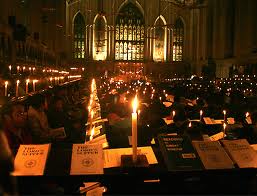
Midnight Mass at St Paul's Cathedral, Calcutta
But, over the years people have started thronging the cathedrals. A friend, who volunteers at the St Paul’s, narrated the tough time they had managing people at this year’s service. They had a strange dilemma. After all it’s an open affair – free to all. But, at the end of the day it’s also a worship and a religious ceremony. So, while on the one hand it would be wrong on their part to keep away people – how could they let spectators take over the occasion jostling out those who had come to offer prayers.

Is this a sudden surge of secular urges among the people ? Obviously not. It’s what we Bengalis call “hujug” – a cheap fad – fanned by the media. The same friend described how sundry local TV Channels wanted to gate crash uninvited to film the ceremonies – as if it was a public theatre.

Park Street (Calcutta) in Christmas spirit
At a deeper level, does it mean our attitudes are changing and there is a greater level of acceptance within society in general of different religious denominations? I am afraid not. We still tend to carry a subtle level of prejudice or subliminal discrimination towards religious minorities amongst us – whether in the neighbourhood, work-place or even in our circle of friends. The roots of this could be deep and the causes many. But, media hype will not change it – what would make a difference is true value-based education, which seems to be lacking even in the new crop of educational institutions (read, commercial schools) flourishing in the state.

Sunday, December 11, 2011

AMRI - some thoughts and a few questions..

Are we Bengalis low on Emotional Quotient ( EQ)?

#seeing the TV coverage of some of the Bengali TV Channels, I certainly thought as a race we are EQ challenged. This was certainly no time or place for feigned histrionics – that most of the anchors were indulging in – led, of course, by the upstart “star” of Star Ananda (who was pretending to gasp for breath inside the wards - compalining of suffocation by "Carbon Monoxide" it seems. First of all, who let him in – before the situation had been brought totally undercontrol ?).

#What was #MamataBanerjee doing there with a Micro-phone screaming instructions – promising to reward the local youth for helping out, advising the relatives of the deceased to proceed to SSKM Hospital Mortuary – where the “dead-bodies were being taken for post-mortem” and wait “patiently” as it would take some time for the “bodies to reach” . Few of her Ministers who had reached the scene were busy giving inane news-bytes to channels. There is none to tell our VIPs that the best way to help in such emergencies is to stay out of the way of those managing the crisis. They can cause more harm than good by their interference eager to score a few cheap political points.

# Perhaps, to prove their ‘professionalism’ the AMRI website put up Excel Sheet list of the “dead” – with noting of “bodies that have been identified”. But – not a word of condolence, mourning or regret. The rest of the pages were left as it is – full of marketing spiel. The next day, however, they did carry advertisements in the inside pages of city newspapers – making it a point to thank the staff “who have shown great courage in saving many lives without a thought to their own safety”, the latter I have no reason to disbelieve or discount.

unfair comparisons ?

A Twitter friend took serious umbrage at a comment of a well-known Mumbai journalist, comparing the AMRI tragedy with the Taj 26/11. He felt the comparisons – especially of Bombay and Calcutta were odious – and I agree with him. But, the point she was trying to make, I think , was a bit different. Is it right to compare the professionalism and dedication of The Taj staff with that of AMRI – even if both are ‘service institutions’ as she argues ?

I have reasons to believe, the junior nursing and the service employees - of organizations like AMRI are under-trained and under-paid. They are mostly drawn from very poor quarters of suburban and rural hinterlands of Calcutta and put on the job with minimum induction. Most of them are contractual employees – not even on the hospital’s permanent rolls. The HR policies of these places – set up with the sole objective of making a quick buck – are not conducive to inculcating any sense of pride or belongingness. The lack of professionalism of the employees would be apparent from their blatant casual attitude – on a visit to the Out-patients Departments of any of these private hospitals. Therefore, I for one am not at all surprised – without trying to justify their action in the slightest – at these junior staff - many of them the sole bread earners in poor families - trying to jump off to save their own lives leaving behind the patients under their care.

About the security staff the less said the better. This has become an industry that breeds more insecurity than security. Remember the Dhananjay episode (where the Security Guard was accused of rape and then hanged). Most security agencies get hold of riff-raffs from the slums for a pittance and put them up with shabby uniforms and no training whatsoever. The old peanuts and monkey theory.

Service institutions must have a different ethos and can’t be run as any other commercial organization. This fact is often not appreciated by promoters – who see it just as another profit making enterprise like any of their other ventures in real-estate, FMCG (Fairness Creams) or Undergarments - just as Doctors no longer remember Hippocrates’ oath.

The business model of many of the mushrooming private hospitals and nursing homes are based on the unholy nexus with Insurance TPA (Third Party claim Assessors) outfits.

Domain expertise counts in running hospitals as much as it does in a paan-shop or restaurant. Medical industry needs its own core-competence – which the Apollos, Escorts, Fortis, Medantas, Manipals, Narayan Hrudalayas even the Jasloks and Leelavatis bring on board to some extent, I hope, and that's not to think they are bereft of commercial interests..

Anjan Dutt – a Bengali singer and actor – put it very well, I thought, on a TV show. Calcutta has been taken over, he said, by a breed of businessmen – who have no love for the city and see it only as an object of exploitation for quick profits. The same mentality seems to afflict – even the successful professionals – most notably among them the Doctors, who have earned a terrible reputation for their lack of professional ethics. That’s a real pity – since Calcutta was once known as a centre of medicine with some of the finest physicians and surgeons of the country in every field of specialization. Today, we have train loads of Bengalis travelling to Chennai and Vellore for treatment (ironically, sometimes to the sister hospitals of the same groups which have affiliates in Calcutta).

Much is being written about the government nominees who were on the Board of AMRI. It seems most of them never attended any meetings and the Chairman - believe it or not - claims that he was even not aware he had been elected to the post.

I know a couple of Trustees of the Breach Candy Hospital in Mumbai. These people take immense pride in their association and, therefore, great interest in the affairs of the hospital. Big names – who are visiting doctors – are extremely demanding on the hospital authorities for medical and support services – as they don’t want their reputation to be compromised.

Here, in Calcutta, people see it only as a ticket for freebies – a perk of being in a position of power or having the right connections  (for the well-known gynaecologist on the board - I am sure it's no more an honour than being the President of The Bengal Club) - and for the hospitals it is a convenient pay-off to flaunt some respectable names on their website.


the first and last resort


The fire-brigade used to be one of our finest outfits. It, probably, is still very good. But, can it be compared with the New York fire-men post 9/11 ? Certainly not. Therefore, it was telling to hear some aggrieved relatives ask – why wasn’t the army called in for the rescue operations. For me – this is indicative of the deep distrust and lack of faith that the general public has developed for most of our public service institutions. The army to them remains the only one that inspires confidence – by the sheer dint of their self-less courage, dedication and discipline.

The sense of service seems to have gone out of our lives – with perhaps, the sole exception of a few religious orders and the armed forces. Consumerism has stolen our hearts and made us irredeemably self-centered.

Wonder what it will take to change that, if ever?